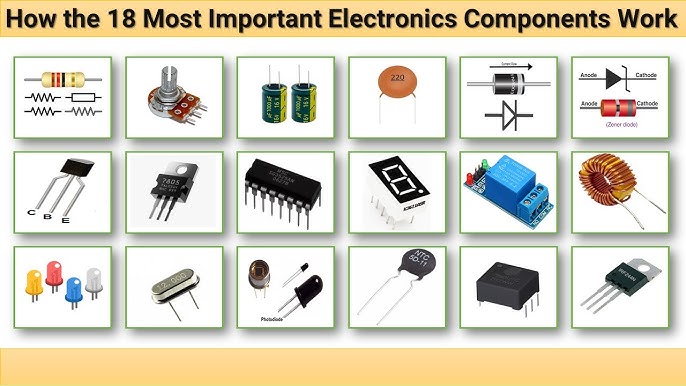
Have you ever wondered what makes your phone light up or your TV display colors so vividly? The answer lies in tiny parts called electronic components.
These small pieces work together to bring your gadgets to life. Understanding the different types of electronic components can give you a new appreciation for the devices you use every day. Whether you’re curious about how things work or planning to build your own electronics, knowing these components is the first step.
Keep reading, and you’ll discover the key players behind every electronic device around you.
Active Components
Active components are the powerhouse of any electronic device. They control the flow of electricity and can amplify signals or switch currents on and off. Unlike passive components, active components need a power source to operate and directly influence the performance of your circuits.
Transistors
Transistors are tiny but mighty electronic switches. They can amplify electrical signals, making them essential in devices like radios, computers, and smartphones.
Think about your phone’s ability to boost weak signals—that’s the transistor at work. They come in various types, such as Bipolar Junction Transistors (BJTs) and Field Effect Transistors (FETs), each with unique roles in circuits.
Diodes
Diodes allow current to flow in only one direction, acting like a one-way gate. This simple function protects circuits from damage and converts AC to DC power.
You might find diodes in your phone charger or LED lights. Special types, like Zener diodes, regulate voltage and keep your devices safe from power surges.
Integrated Circuits
Integrated Circuits (ICs) pack hundreds or thousands of components into a tiny chip. They handle complex tasks, from processing data to controlling power.
Imagine the IC as the brain of your electronic device. Microcontrollers and microprocessors are common ICs you interact with daily in gadgets and appliances.
Passive Components
Passive components are essential parts of electronic circuits. They do not require power to operate but control the flow of electricity. These components store energy or resist current without adding energy to the circuit. Common passive components include resistors, capacitors, and inductors. Each type plays a unique role in shaping how circuits work.
Resistors
Resistors limit electric current in a circuit. They protect sensitive components by controlling voltage and current levels. Resistors come in many sizes and values, measured in ohms (Ω). They can be fixed or variable. Fixed resistors have a set resistance, while variable resistors change resistance as needed. Resistors help divide voltage and reduce current flow.
Capacitors
Capacitors store and release electrical energy quickly. They consist of two conductive plates separated by an insulating material. Capacitors smooth out voltage changes and filter noise in circuits. They are measured in farads (F), usually microfarads (µF) or picofarads (pF). Capacitors also help with timing and signal processing in many devices.
Inductors
Inductors store energy in a magnetic field when current passes through them. They usually look like coils of wire. Inductors resist changes in current and help filter signals. They are measured in henrys (H). Inductors are used in power supplies, radios, and other electronic systems to manage current flow and signal frequency.
Electromechanical Components
Electromechanical components bridge the gap between electrical circuits and mechanical movement. These parts convert electrical signals into physical actions or vice versa. They play a key role in many electronic devices and systems.
Electromechanical components are vital in controlling and connecting circuits. They respond to electrical inputs by moving parts or changing states. These components offer reliability and durability in various applications.
Relays
Relays are switches controlled by electrical signals. They use an electromagnet to open or close contacts. This allows a small current to control a larger current safely. Relays protect circuits from overloads and provide isolation.
Switches
Switches enable users to open or close a circuit manually. They come in many types, such as toggle, push-button, and slide switches. Switches control power flow and signal paths in electronic devices. Their simple design makes them easy to use and maintain.
Connectors
Connectors join electrical circuits together. They provide a secure and removable link between wires or devices. Connectors come in various shapes and sizes to fit different needs. They ensure stable electrical connections and prevent signal loss.

Credit: www.electronicsandyou.com
Display Components
Display components are essential in electronic devices because they transform electrical signals into visual information you can see and understand. They come in various types, each with unique features suited to different applications. Knowing the differences helps you choose the right display for your project or device.
Leds
LEDs, or Light Emitting Diodes, are simple, energy-efficient display components. They produce light when an electric current passes through them, making them perfect for indicators and digital clocks. Have you noticed how bright and sharp the tiny LED lights are on your gadgets? That’s because they emit light directly, without needing a backlight.
Lcds
LCDs, or Liquid Crystal Displays, use liquid crystals to block or allow light to pass, creating images. They require a backlight, usually LED-based, to make the display visible. You’ll find LCDs in devices like calculators, watches, and computer monitors because they offer clear images and consume less power than older technologies.
Oleds
OLEDs, or Organic Light Emitting Diodes, work differently from LCDs by emitting their own light when electricity flows through organic compounds. This means each pixel lights up individually, resulting in deeper blacks and more vibrant colors. If you’ve seen the stunning contrast on modern smartphones or TVs, you’ve seen OLED technology in action.
Sensor Components
Sensors play a crucial role in electronic systems by detecting changes in the environment and sending signals to other components. They act as the eyes and ears of your devices, allowing machines to interact with the physical world. Understanding different types of sensor components can help you choose the right one for your project or troubleshoot existing systems effectively.
Temperature Sensors
Temperature sensors measure heat levels and convert them into readable signals. These sensors are vital in devices like thermostats, ovens, and wearable fitness trackers. You might have noticed how your smartphone adjusts its performance based on temperature readings to prevent overheating.
Common types include thermocouples, thermistors, and infrared sensors. Each type offers unique advantages—thermistors are great for precision, while infrared sensors measure temperature without contact. Choosing the right sensor depends on accuracy needs and environmental factors.
Pressure Sensors
Pressure sensors detect the force exerted by liquids or gases. They are essential in applications ranging from automotive systems to weather monitoring stations. Have you ever wondered how your car knows when to adjust the tire pressure automatically? That’s pressure sensing at work.
These sensors come in various forms, such as piezoelectric, capacitive, and strain gauge types. Piezoelectric sensors generate an electric charge under pressure, making them suitable for dynamic pressure changes. Understanding these types helps you pick the best sensor for your design requirements.
Motion Sensors
Motion sensors detect movement or changes in position. They power everything from security alarms to gaming consoles, making your devices responsive to your actions. Think about how automatic lights turn on when you enter a room—that’s motion sensing creating convenience.
Types include accelerometers, gyroscopes, and ultrasonic sensors. Accelerometers measure linear movement, while gyroscopes detect rotational motion. Knowing the differences helps you decide which sensor fits your project’s motion detection needs.

Credit: www.youtube.com
Power Supply Components
Power supply components are the backbone of any electronic device. They ensure your gadgets get the right amount of energy to function smoothly. Without reliable power supply parts, your circuits might fail or behave unpredictably.
Batteries
Batteries store chemical energy and convert it into electrical energy to power devices. You’ve likely used AA or AAA batteries in household gadgets, but there are also rechargeable lithium-ion batteries in smartphones and laptops. Choosing the right battery depends on capacity, voltage, and size, which directly affect how long your device runs.
Have you ever noticed how some batteries last longer than others in the same device? That’s because battery quality and type vary widely, affecting performance and safety.
Transformers
Transformers change the voltage level of electric power to suit different parts of a circuit. They step voltage up or down, making them essential in power distribution and electronic devices that need specific voltage levels.
If you’ve ever used a laptop charger, you’ve seen a transformer in action—converting high voltage from the wall outlet to a lower voltage your laptop can handle. Selecting the right transformer involves considering input/output voltage, current rating, and frequency.
Voltage Regulators
Voltage regulators maintain a constant voltage level to protect electronic components from damage caused by voltage fluctuations. They ensure your device receives steady power, even if the input voltage varies.
Think about your phone charger: without a voltage regulator, sudden spikes could fry your device’s circuits. These components come in linear and switching types, each with different efficiency levels suitable for various applications.
Rf Components
RF components are essential in any device that sends or receives radio signals. They handle frequencies ranging from a few kilohertz to several gigahertz, making them vital in communication systems, radar, and wireless technology. Understanding these components helps you design or troubleshoot circuits that rely on radio frequency signals effectively.
Antennas
Antennas convert electrical signals into radio waves and vice versa. Different types include dipole, patch, and loop antennas, each suited to specific frequency ranges and applications.
Choosing the right antenna affects your device’s range and signal quality. Have you noticed how your phone’s reception changes when you move around? That’s the antenna’s job adapting to the environment.
Rf Filters
RF filters block unwanted frequencies and allow only the desired signals to pass through. They come in various forms like band-pass, low-pass, and high-pass filters.
Filters improve signal clarity and reduce interference, which is crucial in crowded frequency environments. Think about how static disappears when you adjust a radio station—that’s a filter at work.
Oscillators
Oscillators generate stable RF signals used as carriers in communication systems. They produce continuous waveforms at specific frequencies, which are essential for modulation and timing.
Crystal oscillators are common for their accuracy, while voltage-controlled oscillators offer flexibility. Have you ever wondered how your remote controls or wireless keyboards keep their signals synchronized? Oscillators are behind that precision.

Credit: www.youtube.com
Optoelectronic Components
Optoelectronic components combine light and electronics. They help convert electrical signals into light or vice versa. These parts are vital in many devices such as remote controls, fiber optics, and sensors. They improve communication and sensing technologies with high precision and speed.
Photodiodes
Photodiodes detect light and convert it into electrical current. They work fast and respond to different light intensities. Commonly used in cameras and light meters, photodiodes help measure light accurately. They are small and consume little power, making them ideal for compact devices.
Laser Diodes
Laser diodes emit focused light with high intensity. They are used in barcode scanners, CD players, and fiber optic communication. These diodes produce coherent light, which means the light waves are aligned. Laser diodes are efficient and can be modulated for data transmission.
Optocouplers
Optocouplers transfer signals using light to isolate circuits. They protect sensitive parts from high voltages or noise. Inside, an LED sends light to a photodetector, which creates an electrical output. Optocouplers are important in power supplies and signal isolation in electronics.
Frequently Asked Questions
What Are The Main Types Of Electronic Components?
Electronic components mainly include resistors, capacitors, inductors, diodes, and transistors. Each serves a unique function in circuits, enabling control of current, voltage, and signal processing.
How Do Passive And Active Components Differ?
Passive components like resistors and capacitors do not require power to operate. Active components, such as transistors and ICs, need an external power source to function and amplify signals.
Why Are Semiconductors Important In Electronics?
Semiconductors control electrical conductivity, essential for modern electronics. Components like diodes and transistors rely on semiconductors to switch and amplify electronic signals effectively.
What Role Do Capacitors Play In Circuits?
Capacitors store and release electrical energy quickly. They stabilize voltage, filter noise, and enable signal coupling in various electronic applications.
Conclusion
Electronic components build the foundation of all gadgets. Resistors, capacitors, and transistors each play a special role. Understanding their types helps in fixing or making devices. These parts connect and work together to create circuits. Knowing basic components makes technology less confusing.
Everyone can learn and enjoy electronics with time. Keep exploring, and you will find new uses. Small pieces, big impact.
Leave a Reply