Are you curious about how your gadgets work or want to build your own electronic projects? Understanding electronic components is the first step.
This simple guide breaks down the basics so you can easily grasp what each part does and how they fit together. By the end, you’ll feel confident identifying components and using them in your own creations. Ready to unlock the secrets behind the tiny parts that power your devices?
Keep reading to discover everything you need to know in clear, straightforward terms.

Credit: www.electronicsandyou.com
Basic Electronic Components
Understanding basic electronic components is key to building and repairing circuits effectively. These small parts control how electricity flows and interacts, shaping the behavior of any electronic device. Knowing what each component does gives you the power to troubleshoot and innovate with confidence.
Resistors
Resistors control the flow of electric current by providing resistance. Think of them as traffic regulators that slow down electrons to prevent damage to other parts. You’ll often see them labeled with color bands indicating their resistance value, which you can decode using a simple chart.
Have you ever tried to light an LED without a resistor? It usually burns out quickly because too much current flows through. Adding the right resistor keeps your circuit safe and working perfectly.
Capacitors
Capacitors store and release electrical energy, acting like tiny batteries that charge and discharge rapidly. They help smooth out voltage fluctuations and filter signals in your circuits. Capacitors come in many types, such as ceramic and electrolytic, each suited for different tasks.
If you’re designing a power supply, capacitors are essential for stabilizing the output voltage. Have you noticed how your phone charger uses capacitors to keep the power steady despite changes in current draw?
Inductors
Inductors store energy in a magnetic field when current passes through them. They resist changes in current, which makes them useful in filters and tuning circuits. You usually find inductors as coils of wire, sometimes wrapped around a magnetic core to increase their strength.
Curious how radios tune into specific stations? Inductors play a big role in selecting the right frequency by working with capacitors. Understanding inductors opens up more possibilities for creating complex circuits.
Diodes
Diodes allow current to flow in only one direction, acting like one-way valves for electricity. This property makes them vital for converting AC to DC power and protecting circuits from reverse polarity. The most common type you’ll encounter is the silicon diode, recognizable by its black body and silver band.
Ever wondered how your phone charger converts wall electricity to a safe charge? Diodes inside the charger make sure electricity flows correctly and safely. Knowing how diodes work can help you fix power-related issues with your gadgets.
Active Components
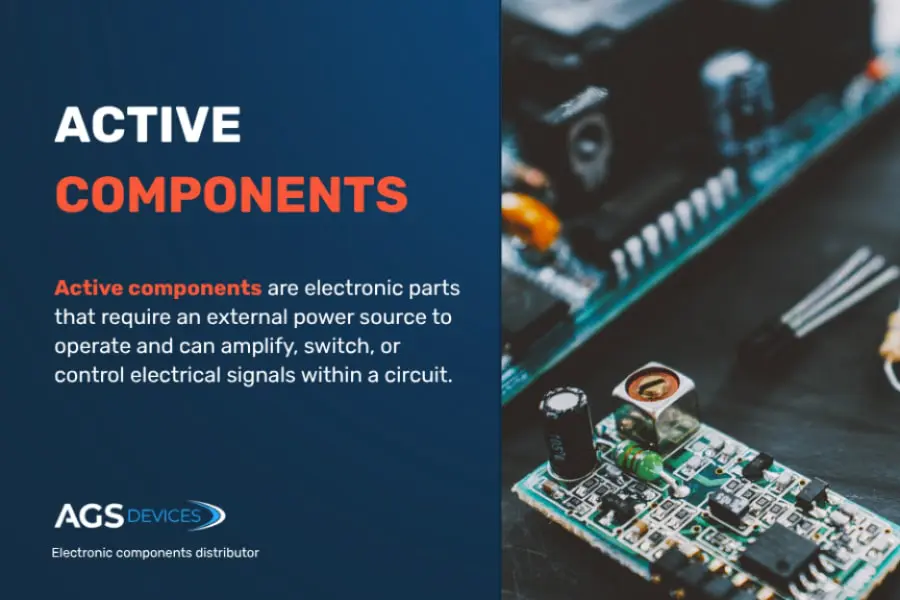
Active components are the heart of any electronic device. They control the flow of electricity and can amplify signals or switch them on and off. Without these components, your gadgets wouldn’t function the way you expect.
Transistors
Transistors are tiny but powerful devices. They can act as amplifiers or switches in circuits. Think about your smartphone; transistors inside it help amplify sound and process signals rapidly.
Using just a few transistors, you can create complex circuits. They come in different types, like bipolar junction transistors (BJTs) and field-effect transistors (FETs), each with specific uses.
Have you ever wondered how your computer’s processor handles billions of operations? It’s all thanks to millions of transistors working together seamlessly.
Integrated Circuits
Integrated circuits (ICs) combine many active components, including transistors, into a single chip. This miniaturization saves space and enhances performance. Inside your TV remote or washing machine, ICs manage complex tasks efficiently.
ICs vary widely—from simple logic gates to microcontrollers that act like tiny computers. This variety means you can find an IC for almost any electronic project or repair.
Imagine designing a circuit without ICs; it would be bulky and complicated. How would your projects change if you had to build each function with separate components?
Understanding Circuit Boards
Understanding circuit boards is key to working with electronic components effectively. These boards serve as the foundation where all components connect and communicate. By grasping how different types of circuit boards work, you can build, test, and repair circuits with confidence.
Breadboards
Breadboards are your best friends when testing and experimenting with circuits. They let you plug in components without soldering, so you can quickly change connections and troubleshoot. Have you ever felt stuck because a soldered connection was wrong? Breadboards eliminate that frustration.
They consist of a grid of holes with metal strips underneath that connect certain rows and columns. You just insert wires and components into these holes to form a circuit. This setup is perfect for beginners and for projects where you expect frequent adjustments.
- No soldering required
- Reusable and flexible
- Great for prototyping and learning
Printed Circuit Boards
Printed Circuit Boards (PCBs) are what you find inside almost all finished electronic devices. Unlike breadboards, PCBs have permanent copper pathways etched onto a rigid board that connect the components. This makes your circuit more reliable and compact.
Designing a PCB requires planning your layout carefully since changes after manufacturing are difficult. But once done, PCBs improve your device’s durability and performance. Have you ever held a device and wondered how tiny parts connect so neatly? PCBs are the answer.
- Permanent and durable connections
- Compact and efficient design
- Customizable for complex circuits

Credit: www.electronicsandyou.com
Tools For Working With Electronics
Working with electronics requires the right tools to make tasks easier and more accurate. Basic tools help test, fix, and build electronic devices. They ensure safety and improve the quality of your work.
This section covers two essential tools every electronics hobbyist should have: the multimeter and the soldering iron.
Multimeter
A multimeter measures electrical values like voltage, current, and resistance. It helps check if circuits work correctly or find problems.
- Digital multimeters show clear readings on a screen.
- They have probes to touch different points in a circuit.
- Some models include extra features like testing diodes and continuity.
Using a multimeter is simple and safe. It gives quick feedback on your electronic components and wiring.
Soldering Iron
A soldering iron joins electronic parts by melting solder wire. This creates strong electrical connections on circuit boards.
- Choose a soldering iron with adjustable temperature control.
- A fine tip helps work on small components accurately.
- Always use a stand to hold the hot iron safely.
Proper soldering improves device reliability and prevents loose connections. Practice steady hands and clean tips for best results.
Safety Tips For Beginners
Safety is crucial when working with electronic components, especially if you’re just starting out. Mistakes can damage parts or even cause injury. Taking simple precautions helps you avoid these risks and builds your confidence to experiment and learn.
Handling Components Safely
Always ground yourself before touching sensitive electronic parts. Static electricity can destroy delicate components in an instant. A wrist strap or touching a metal object frequently keeps your body discharge-free.
Keep your workspace clean and organized. Clutter can lead to accidental damage or mixing up parts. Store components in labeled containers to find them easily and prevent loss.
Use the right tools for the job. Needlenose pliers, tweezers, and a good soldering iron make handling small parts easier and safer. Avoid using your fingers for tasks that require precision to reduce the risk of injury.
Avoiding Common Mistakes
Check the polarity and ratings of components before connecting them. Reversing a diode or capacitor can cause them to fail or even explode. Take a moment to double-check datasheets or component markings.
Never work on a live circuit without proper knowledge. It’s tempting to test things while powered, but it increases the chance of shock or short circuits. Always disconnect power before making adjustments.
Don’t rush your work. Hurrying leads to loose connections or wrong wiring. Slow down and verify each step—your future self will thank you when the circuit works perfectly.

Credit: www.electronicsandyou.com
Resources For Learning
Finding the right resources can make learning about electronic components much easier and more enjoyable. Whether you prefer reading detailed guides or interacting with others who share your interests, plenty of options are available. Let’s look at some reliable sources that can help you build your knowledge effectively.
Books And Online Courses
Books remain a valuable tool for understanding electronic components. Titles like “Make: Electronics”by Charles Platt provide clear explanations and hands-on experiments that help you learn by doing.
Online courses offer flexibility and interactive content. Platforms like Coursera and Udemy feature beginner-friendly classes on electronics fundamentals. Many courses include videos, quizzes, and projects, which keep you engaged and help solidify your understanding.
Have you tried combining both books and courses in your learning routine? This mix can reinforce concepts and give you different perspectives on the same topic.
Community Forums And Groups
Joining forums and groups connects you with people who share your passion and challenges. Websites like the Electronics Stack Exchange and Reddit’s r/electronics let you ask questions and get answers from experienced hobbyists and professionals.
Local maker spaces and online communities often host workshops and discussions. Participating in these can provide real-time feedback and motivate you to keep experimenting.
What questions have you been hesitant to ask? Sometimes, a community can offer insights you won’t find in books or courses.
Frequently Asked Questions
What Are The Most Common Electronic Components?
Common components include resistors, capacitors, diodes, transistors, and integrated circuits. Each has a specific function in circuits.
How Do Resistors Work In Electronic Circuits?
Resistors limit electrical current flow and control voltage levels. They protect sensitive components from excess current.
Why Are Capacitors Important In Electronics?
Capacitors store and release electrical energy. They filter signals, smooth power supply fluctuations, and manage timing functions.
What Role Do Transistors Play In Electronics?
Transistors amplify or switch electronic signals. They are fundamental in building amplifiers, switches, and digital circuits.
Conclusion
Electronic components form the building blocks of many devices. Knowing their basic types helps you understand how gadgets work. Simple parts like resistors and capacitors have clear roles. Circuits come alive when these pieces connect correctly. Learning about components makes projects easier and more fun.
Keep exploring step by step to gain more confidence. Small knowledge grows into bigger skills over time. Electronics can be simple with the right approach. Start with basics and build from there.
Leave a Reply