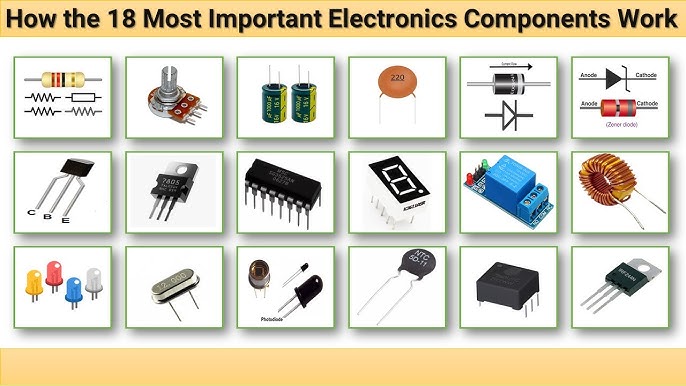
Are you curious about what makes your gadgets work? Understanding the basic components in electronics is the first step to unlocking the magic behind every device you use daily.
Whether you want to fix a broken phone, build a simple circuit, or just impress your friends with tech knowledge, knowing these components will give you the power to do it. Keep reading, and you’ll discover the building blocks that bring electronics to life—and how they affect everything around you.
Your journey into the heart of technology starts here.
Key Electronic Components
Basic electronic components include resistors, capacitors, diodes, and transistors. These parts control electric current and form the building blocks of circuits. Understanding their functions helps in designing and fixing electronic devices.
Understanding the basic components in electronics is like learning the alphabet of a new language. Each component plays a unique role, contributing to the functionality of the entire circuit. Grasping their functions can empower you to troubleshoot devices or even create your own gadgets. Let’s delve into some of the key electronic components that form the building blocks of modern electronics.Resistors And Their Types
Resistors are the unsung heroes in electronics. They limit the flow of electric current, protecting other components from damage. You will find various types like carbon film, metal film, and wire-wound resistors, each suited for different applications. Ever noticed how some resistors have color bands? These bands represent their resistance value, helping you choose the right one for your project.Capacitors In Circuits
Capacitors store and release electrical energy, similar to tiny batteries. They are crucial in filtering out noise and stabilizing voltage in power supplies. From ceramic to electrolytic capacitors, each type serves a specific purpose. Have you ever wondered why your radio maintains signal clarity? Capacitors help filter out unwanted frequencies, ensuring a crisp sound.Inductors And Their Uses
Inductors, often found in coils, resist changes in current. They are widely used in transformers and to filter signals in electronic circuits. Their ability to store energy in a magnetic field makes them indispensable in power supplies. Next time you adjust the volume on a speaker, think about how inductors help manage those audio signals smoothly.Diodes And Their Functions
Diodes are like one-way streets for electric current. They allow current to flow in only one direction, preventing reverse currents that can cause damage. Common applications include rectifying AC to DC power and protecting circuits from voltage spikes. Have you ever tried using an LED? It’s a type of diode that lights up when current passes through it, illustrating their versatility.Transistors As Switches And Amplifiers
Transistors are the building blocks of modern electronics, acting as both switches and amplifiers. They control the flow of current and can amplify weak signals, making them essential in radios, computers, and more. Imagine controlling a large current with a small switch—transistors make this possible, revolutionizing how devices operate.Integrated Circuits Explained
Integrated Circuits (ICs) are like miniaturized electronic circuits packed into a single chip. They contain multiple components like transistors, resistors, and capacitors working together. ICs power everything from your smartphone to your coffee maker. Think about the complexity of a computer’s processor, all condensed into a tiny piece of silicon—that’s the magic of integrated circuits. Understanding these components not only demystifies electronics but also opens up a world of possibilities. Which component are you most curious about?Component Functions
Every electronic device relies on basic components that perform specific functions to make circuits work. Understanding these component functions helps you grasp how electricity is controlled, stored, and manipulated within a device. Let’s break down what each component does and why it matters to your projects or repairs.
Controlling Current With Resistors
Resistors limit the amount of electric current flowing through a circuit. Think of them as the traffic cops of electricity, slowing down or reducing current to safe levels. Without resistors, delicate parts could burn out from too much current.
Have you noticed how a dimmer switch changes light brightness? That’s resistors controlling current to adjust intensity. They’re simple but essential in protecting and tuning your electronics.
Storing Energy In Capacitors
Capacitors store and release electrical energy quickly, acting like tiny batteries. They smooth out voltage fluctuations, which keeps devices running steadily.
If you’ve seen a camera flash, capacitors charge up and then release energy in a burst to power the flash. This quick energy storage and release make them crucial in timing and filtering circuits.
Magnetic Fields In Inductors
Inductors store energy in magnetic fields created by current flowing through coils of wire. They resist changes in current, helping to filter signals and manage power.
Imagine tuning a radio—inductors help select the correct frequencies by blocking or allowing certain signals. They’re key players in controlling how energy flows over time.
Current Direction With Diodes
Diodes let current flow in only one direction, preventing damage from reverse currents. This one-way street protects components and ensures proper circuit operation.
Think about your phone charger; diodes stop electricity from flowing back into the power source, which could cause damage. They’re simple but vital for circuit safety.
Signal Amplification Using Transistors
Transistors amplify weak electrical signals, making them stronger and usable in devices like radios and computers. They can also act as switches to turn circuits on or off.
When I first built a small radio, the transistor was the heart of the circuit, boosting signals so I could actually hear sound. Without transistors, modern electronics wouldn’t exist.
Complex Operations In Integrated Circuits
Integrated Circuits (ICs) combine hundreds or thousands of components into one small chip. They perform complex tasks like processing data, memory storage, and controlling systems.
Your smartphone’s brain is an IC, handling everything from running apps to managing hardware. Understanding ICs helps you appreciate how much power fits into tiny spaces.
Common Component Specifications
Understanding common component specifications is key in electronics. These specs define how parts behave in circuits and affect overall performance. Knowing these details helps select the right components for any project.
Each type of component has unique specs that matter. These specs include electrical values, tolerances, and physical characteristics. They guide engineers and hobbyists in building reliable and efficient devices.
Resistance And Tolerance
Resistance measures how much a resistor limits current flow. It is shown in ohms (Ω). Resistors also have tolerance, which tells how close the real resistance is to the labeled value.
- Common tolerance values: 1%, 5%, 10%
- Lower tolerance means higher precision
- Important for circuits requiring exact current control
Capacitance And Voltage Ratings
Capacitance is the ability of a capacitor to store charge. It is measured in farads (F), usually microfarads (µF) or picofarads (pF).
Voltage rating shows the maximum voltage the capacitor can handle safely.
- Exceeding voltage rating may cause failure
- Choose capacitance and voltage based on circuit needs
Inductance Values
Inductors store energy in a magnetic field when current passes through. Inductance is measured in henries (H), often microhenries (µH) or millihenries (mH).
Inductance value affects how the inductor responds to changes in current and frequency.
Diode Forward Voltage
Forward voltage is the voltage needed for a diode to conduct current. It varies by diode type.
- Silicon diodes typically have 0.7V forward voltage
- Schottky diodes have lower forward voltage (around 0.3V)
- Important for power and signal circuit design
Transistor Gain And Types
Gain, or hFE, shows how much a transistor amplifies current. It varies between different transistors.
Types include Bipolar Junction Transistors (BJTs) and Field Effect Transistors (FETs).
- BJTs have current gain and use base, collector, emitter pins
- FETs control current using voltage at the gate
- Select transistor type based on switching and amplification needs
Ic Pin Configurations
Integrated Circuits (ICs) have specific pin layouts for power, input, and output.
Pin configuration guides correct connection and prevents damage.
- Datasheets provide detailed pin maps
- Common packages: DIP, SOIC, QFN
- Correct pin use ensures proper IC function
Credit: www.agsdevices.com
Applications Of Basic Components
Basic electronic components form the foundation of countless devices and systems you interact with daily. Understanding their applications helps you see how simple parts work together to solve complex problems. From powering gadgets to processing signals, each component has a unique role that shapes the electronics around you.
Power Regulation Circuits
Power regulation circuits ensure that devices receive a steady and safe voltage level. Components like voltage regulators and capacitors smooth out fluctuations that could damage sensitive electronics. Have you ever wondered why your phone charger doesn’t overheat despite varying power sources? These circuits are the reason.
Signal Processing
Signal processing uses components such as resistors, capacitors, and transistors to modify electrical signals. This is essential in audio devices, radios, and sensors to enhance or extract useful information. Think about how your headphones adjust sound quality—basic components are at work behind the scenes.
Filtering And Timing
Filtering removes unwanted parts of a signal, while timing circuits control when actions happen. Capacitors and inductors often work together to filter noise or create delays. Ever noticed the delay before a camera flash? That pause is controlled by timing components ensuring perfect synchronization.
Switching And Amplification
Switching components like transistors act as electronic on/off switches, controlling larger currents with small signals. Amplification boosts weak signals so they become strong enough to drive speakers or other devices. Your voice on a phone call sounds clear because these components manage the signal’s strength.
Digital Logic Functions
Logic gates built from transistors perform basic decisions in digital circuits—like AND, OR, and NOT operations. These functions make computers, calculators, and digital watches work by processing binary data. Next time you use a digital device, remember it’s these simple components making complex choices instantly.
Testing And Identifying Components
Testing and identifying electronic components is a crucial skill that saves you time and money. It helps you confirm if a part is working before installation or diagnose faults in a circuit. Knowing how to test components accurately ensures your projects run smoothly and prevents unnecessary replacements.
Using Multimeters
A multimeter is your best friend for checking components. It can measure voltage, current, and resistance, which are key to identifying if a component is functional. For example, test a resistor by measuring its resistance and compare it to its color-coded value.
Use the continuity setting to check if wires or fuses are intact. When testing diodes, the multimeter’s diode mode shows forward voltage drop, indicating if the diode is good or damaged. Always disconnect components from the circuit for accurate readings.
Visual Inspection Tips
Before testing with tools, look closely at the components. Damaged parts often show burn marks, cracks, or bulging, especially capacitors. Even tiny cracks in a transistor or resistor can cause failure.
Look for corrosion on leads or solder joints, as this can interrupt connections. You might spot a blown fuse just by its broken wire inside the glass. Your eyes can catch issues that tests sometimes miss.
Reading Component Codes
Component codes are like a language telling you their values and specifications. Resistors use color bands, while capacitors and semiconductors often have printed alphanumeric codes. Learning to decode these helps you avoid guesswork.
For example, a resistor with bands brown-black-red means 1k ohms. Capacitors might show values like “104,” meaning 100,000 pF or 0.1 µF. Keep a reference chart handy or use apps that decode codes instantly.
Testing In Circuits
Testing components without removing them from a circuit can be tricky but saves time. Some multimeters offer in-circuit testing modes that help check components under real conditions. However, parallel paths in a circuit can affect measurements.
Use selective probing and compare readings with datasheets or known good circuits. If a component behaves unexpectedly, isolate it by removing one leg or desoldering a single pin. This practical approach helps pinpoint faults faster.

Credit: www.electronicsandyou.com

Credit: www.electronicsandyou.com
Frequently Asked Questions
What Are The Basic Electronic Components?
Basic electronic components include resistors, capacitors, diodes, transistors, and inductors. They control current flow, store energy, and amplify signals.
How Do Resistors Function In Electronics?
Resistors limit electrical current and control voltage levels. They protect circuits by reducing excess current and dividing voltage.
What Role Do Capacitors Play In Circuits?
Capacitors store and release electrical energy. They smooth power supply fluctuations and filter signals in electronic circuits.
Why Are Transistors Important In Electronics?
Transistors amplify signals and act as switches. They enable complex functions like processing and controlling electronic devices.
Conclusion
Understanding basic electronic components helps you grasp how devices work. Resistors, capacitors, and transistors play key roles in circuits. Each part has a simple job but works together to create complex functions. Knowing these basics builds a strong foundation for learning more.
Electronics become less confusing and more interesting with this knowledge. Keep exploring and practicing to improve your skills step by step. Small efforts lead to big progress in electronics learning.
Leave a Reply