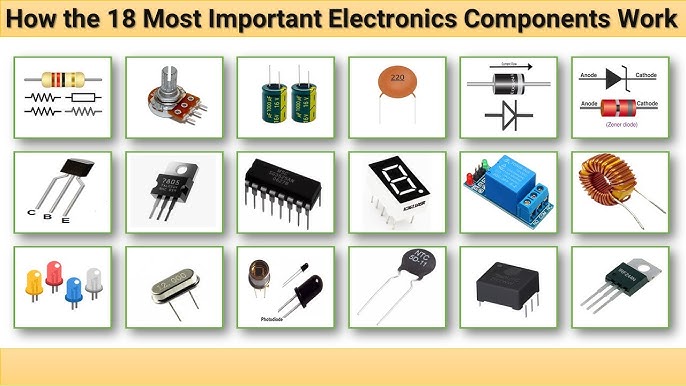
Have you ever wondered what makes your gadgets work? The secret lies in basic electronic components.
These tiny parts form the foundation of every electronic device you use daily. Understanding them can open up a world of possibilities, whether you want to fix a broken device or build your own. You’ll discover what these components are, how they work, and why they matter to you.
Keep reading—you’re about to unlock the essentials of electronics in the simplest way possible.
Resistors
Resistors are one of the most basic electronic components. They control the flow of electric current in a circuit. Resistors help protect sensitive parts by limiting current. Their role is crucial in shaping circuit behavior and performance.
Types Of Resistors
- Fixed Resistors: Provide a constant resistance value.
- Variable Resistors: Allow adjustment of resistance manually.
- Carbon Film Resistors: Made from carbon film, common in general use.
- Metal Film Resistors: More precise and stable than carbon types.
- Wire Wound Resistors: Made from coiled wire, handle higher power.
- Thermistors: Resistance changes with temperature.
How Resistors Work
Resistors slow down electric current by providing resistance. They convert electrical energy into heat. The higher the resistance, the less current passes through. Resistance is measured in ohms (Ω). Different materials and sizes affect resistance value.
Applications In Circuits
- Current Limiting: Protect LEDs and other components.
- Voltage Division: Create specific voltages within a circuit.
- Signal Conditioning: Adjust signal levels for processing.
- Timing Circuits: Work with capacitors to control timing.
- Pull-up/Pull-down: Set default logic levels in digital circuits.

Credit: www.youtube.com
Capacitors
Capacitors are fundamental electronic components used in many circuits. They store and release electrical energy quickly. You can find capacitors in radios, computers, and power supplies. Their ability to hold charge helps control voltage and smooth signals. Understanding capacitors is key to grasping basic electronics.
Types Of Capacitors
- Ceramic Capacitors: Small and common, used for high-frequency circuits.
- Electrolytic Capacitors: Larger, with high capacitance, used in power supplies.
- Tantalum Capacitors: Stable and reliable, often in portable devices.
- Film Capacitors: Known for low loss, used in audio and signal circuits.
- Supercapacitors: Store large amounts of energy, used in backup power.
Functionality And Uses
Capacitors block direct current while allowing alternating current to pass. They filter noise from signals and stabilize voltage in circuits. Capacitors help in timing applications by charging and discharging at set rates. They also couple signals between different parts of a circuit. Many electronic devices rely on capacitors for smooth operation.
Energy Storage In Circuits
Capacitors store energy as an electric field between two plates. When connected to a power source, they accumulate charge. This stored energy can release instantly when needed. It helps to maintain power flow during short interruptions. Capacitors also protect circuits by absorbing voltage spikes. Their quick charge and discharge make them ideal for energy management.
Inductors
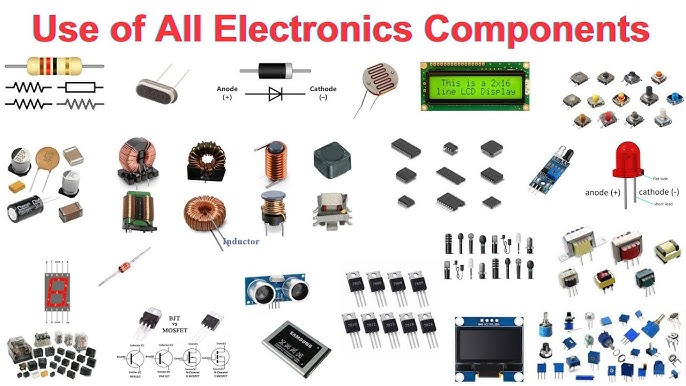
Inductors are basic electronic components that store energy as a magnetic field. They consist of a coil of wire, usually wrapped around a core. When current flows through the coil, it creates a magnetic field. This magnetic field opposes changes in current. Inductors are key parts in many electronic circuits.
Inductor Variants
- Air Core Inductors: No magnetic core, used for high-frequency circuits.
- Iron Core Inductors: Use iron cores to increase inductance.
- Ferrite Core Inductors: Made with ferrite material, common in power supplies.
- Toroidal Inductors: Ring-shaped cores, reduce electromagnetic interference.
- Variable Inductors: Allow manual adjustment of inductance.
Role In Electronic Circuits
Inductors control current and filter signals. They resist sudden changes in current flow. This makes them useful in smoothing power supply outputs. Inductors also work with capacitors to create tuned circuits. These circuits select or reject specific frequencies. They help in signal processing and radio communication.
Applications And Examples
- Power Supplies: Inductors smooth voltage and reduce noise.
- Radio Transmitters: Help tune frequencies for clear signals.
- Filters: Remove unwanted signals in audio and radio devices.
- Transformers: Use inductors to transfer energy between circuits.
- Energy Storage: In switching power supplies and DC-DC converters.
Credit: www.youtube.com
Diodes
Diodes are fundamental electronic components that control the direction of electrical current. They allow current to flow in one direction while blocking it in the opposite direction. This simple yet crucial function makes diodes essential in many electronic circuits.
Types And Characteristics
Several types of diodes exist, each with unique features. Common types include:
- Standard (Silicon) Diode: Most basic type, used for general purposes.
- Zener Diode: Allows current to flow backward at a specific voltage.
- Light Emitting Diode (LED): Emits light when current flows through it.
- Schottky Diode: Has a low forward voltage drop and fast switching.
Diodes have two terminals: anode and cathode. The forward voltage drop is typically around 0.7 volts for silicon diodes. Zener diodes have a breakdown voltage that defines their operation.
Rectification And Switching
Diodes are widely used for rectification, converting AC to DC. They allow only the positive half of the AC waveform to pass. This process is vital in power supplies.
Diodes also function as switches in circuits. They can quickly turn on or off current flow. This property is useful in signal modulation and protection circuits.
Common Uses In Electronics
- Power supply circuits to convert AC to DC.
- Protecting circuits by blocking reverse polarity.
- Lighting with LEDs in displays and indicators.
- Voltage regulation using Zener diodes.
- High-speed switching in digital circuits.
Transistors
Transistors are the building blocks of modern electronics. They control electrical signals and power in countless devices you use every day. Understanding transistors will give you a solid foundation in how electronic circuits work.
Different Types
There are several types of transistors, each designed for specific purposes. The most common types are:
- Bipolar Junction Transistors (BJT): These use both electrons and holes as charge carriers.
- Field Effect Transistors (FET): These control current using an electric field and are known for high input impedance.
- Metal-Oxide-Semiconductor FETs (MOSFET): A subtype of FETs widely used in digital circuits.
Knowing which type fits your project can save you time and improve performance. Have you ever chosen the wrong transistor and wondered why your circuit didn’t work?
Amplification And Switching
Transistors amplify weak signals, making them stronger without changing the original information. This is crucial in audio devices where small microphone signals must be boosted.
They also act as switches, turning current on or off in a circuit. This switching ability powers everything from simple LED lights to complex microprocessors.
Think about your smartphone; the tiny transistors inside switch millions of times per second to handle calls, texts, and apps seamlessly. What everyday devices do you think wouldn’t exist without transistor switching?
Transistors In Modern Circuits
Modern electronics rely on transistors in integrated circuits (ICs), where thousands or even millions of them fit on a single chip. This miniaturization enables powerful computers and compact gadgets.
Transistors also improve energy efficiency. For example, they help regulate power in battery-operated devices, extending your gadget’s life between charges.
Next time you use a device, consider how transistors work behind the scenes to make it fast, reliable, and energy-efficient. How will your understanding of transistors change the way you design or repair electronics?
Integrated Circuits
Integrated circuits, often called ICs, are small electronic chips. They contain many tiny components like transistors and resistors. These components work together to perform specific tasks. ICs are the heart of most electronic devices today. They help make gadgets smaller, faster, and more efficient.
Understanding Ics
ICs are made by placing many electronic parts on a single piece of semiconductor material. Usually, this material is silicon. The parts inside an IC connect with tiny wires or metal lines. This design allows them to work as one unit. ICs can perform simple tasks or very complex functions.
Applications And Benefits
ICs are everywhere. They power smartphones, computers, and home appliances. Their small size saves space in devices. They also use less power than separate components. ICs help improve device speed and reliability. These benefits make electronics affordable and easy to produce.
Common Types Of Ics
- Digital ICs:Handle digital signals. Used in computers and calculators.
- Analog ICs:Work with continuous signals. Found in amplifiers and radios.
- Mixed-Signal ICs:Combine digital and analog functions. Used in smartphones and sensors.
- Microcontrollers:Small computers on a chip. Control devices like microwaves and cars.
Switches
Switches are essential components in any electronic setup. They control the flow of electricity by opening or closing circuits. Without switches, turning devices on and off would be cumbersome and inefficient.
Types Of Switches
You’ll find several types of switches, each designed for specific tasks. Some common ones include:
- Toggle Switches:The classic on/off switch you flip up or down.
- Push Button Switches:Activated by pressing, often found in keyboards and doorbells.
- Slide Switches:These slide from one position to another, like volume controls on some devices.
- Rotary Switches:Turned to select different circuit paths, common in old radios.
- Micro Switches:Small and sensitive, used in safety devices and appliances.
Knowing the type helps you pick the right switch for your project. Have you ever struggled choosing a switch and ended up with the wrong one?
Switch Functions
Switches serve to start or stop electrical flow, but their roles go deeper. Some switches control multiple circuits, while others provide momentary contact, only staying active while pressed.
Think about your computer’s power button – it’s a momentary switch. A toggle switch in a lamp provides a stable on/off state. Understanding these functions helps you design smarter circuits.
Integration In Circuits
Integrating switches is straightforward but requires attention to detail. You connect them in series with the load to control current flow effectively.
Wiring a switch incorrectly can cause short circuits or device failure. Always double-check your connections and test the switch before finalizing your build.
Next time you design a circuit, consider how the switch fits into your overall plan. How will you ensure it operates reliably under different conditions?
Connectors
Connectors are essential parts of electronic devices. They join different components, allowing electricity and signals to flow smoothly. Without connectors, assembling and repairing electronics would be very difficult. They create a bridge between wires, circuit boards, and devices.
Varieties Of Connectors
Connectors come in many shapes and sizes. Some common types include:
- Pin connectors
- USB connectors
- Coaxial connectors
- RJ45 connectors
- Terminal blocks
- Ribbon cable connectors
Each type fits specific uses and devices. Some connect power, others handle data signals.
Connector Functions
Connectors join electrical circuits without soldering. They make connections easy to assemble and disassemble. They ensure secure and stable contact between parts. Connectors protect against electrical shorts and interference. They also help in organizing complex wiring systems.
Importance In Electronics
Connectors ensure devices work properly by providing reliable links. They reduce damage during assembly and maintenance. They save time by allowing quick replacements and upgrades. Connectors support device safety by preventing loose connections. Without connectors, modern electronics would be complex and fragile.
Batteries
Batteries are a vital part of many electronic devices. They store energy and provide power without needing a constant plug. This makes devices portable and easy to use anywhere. Batteries come in many shapes and sizes, each serving different needs. Understanding batteries helps in choosing the right power source for your electronics.
Types Of Batteries
- Alkaline:Common and inexpensive. Used in remote controls, clocks.
- Rechargeable (NiMH, Li-ion):Can be charged many times. Found in phones, laptops.
- Lead-Acid:Large and heavy. Used in cars and backup power systems.
- Button Cells:Small and round. Used in watches, hearing aids.
Battery Operation
Batteries work by converting chemical energy into electrical energy. Inside, chemical reactions create a flow of electrons. This flow powers electronic circuits. Batteries have two terminals: positive and negative. The current flows from the negative to the positive terminal through the device.
Over time, the chemicals inside the battery get used up. This reduces the battery’s ability to hold charge. Rechargeable batteries can restore chemicals by reversing the reaction with electricity.
Usage In Electronic Devices
Batteries power many devices without a direct power source. Portable gadgets like smartphones, cameras, and tablets rely on batteries. Toys, flashlights, and wireless mice also use batteries.
Choosing the right battery type affects device performance and lifespan. Devices with high power needs often use rechargeable batteries. Small or low-power devices often use alkaline or button cells.

Credit: www.youtube.com
Printed Circuit Boards
Printed Circuit Boards (PCBs) are the backbone of almost every electronic device you use daily. They connect and support electronic components, making complex circuits manageable and compact. Understanding PCBs helps you appreciate how devices function and opens doors to designing your own electronics.
Pcb Basics
A PCB is a flat board made from insulating material, usually fiberglass, with thin copper tracks etched on its surface. These copper paths connect different electronic components like resistors, capacitors, and chips. Instead of messy wires, PCBs keep everything organized and reliable.
PCBs come in various layers: single-sided, double-sided, or multi-layered. Each layer adds more complexity and allows for more connections in a smaller space. Have you ever wondered how your smartphone fits so many functions in such a tiny body? PCBs are a big part of that answer.
Design And Manufacture
Designing a PCB starts with a schematic diagram of the circuit. Then, designers use specialized software to lay out the copper tracks and place components. This step needs careful planning to avoid short circuits and ensure signal quality.
Manufacturing a PCB involves printing the design onto the board, etching away unwanted copper, and then drilling holes for component leads. After that, components are soldered onto the board, either by hand or using automated machines. The precision in this process affects the device’s performance and durability.
Role In Electronic Devices
PCBs serve as the platform where all electronic magic happens. They provide mechanical support and electrical connections, turning separate components into a functioning system. Without PCBs, devices would be bulky, unreliable, and difficult to repair.
Think about your laptop or TV. The smooth operation depends on well-designed PCBs that handle power distribution, signal processing, and data flow efficiently. What electronic device would you be most interested in building once you understand how PCBs work?
Frequently Asked Questions
What Are The Basic Electronic Components?
Basic electronic components include resistors, capacitors, diodes, transistors, and inductors. They control current, store energy, and amplify signals in circuits.
How Do Resistors Work In Electronics?
Resistors limit electric current flow and reduce voltage within circuits. They protect sensitive components and control signal levels for proper device function.
What Is The Role Of Capacitors In Circuits?
Capacitors store and release electrical energy quickly. They smooth power supply fluctuations and filter signals in electronic devices for stable operation.
Why Are Diodes Important In Electronics?
Diodes allow current to flow in one direction only. They protect circuits from damage and convert alternating current (AC) to direct current (DC).
Conclusion
Basic electronic components form the heart of all electronic devices. Each part has a simple job but works together to create complex systems. Understanding these parts helps you learn how electronics function. Start with resistors, capacitors, and diodes. Then explore transistors and integrated circuits.
Practice and hands-on projects make learning easier. Electronics become less confusing with time and effort. Keep exploring and experimenting to build your skills. This knowledge opens many doors in technology and daily life.
Leave a Reply