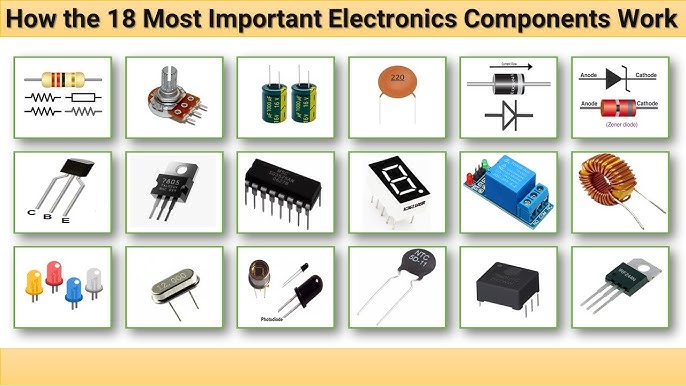
Have you ever wondered what makes your gadgets come to life? The secret lies in tiny parts working together inside every electronic device.
Understanding the components of electronics can open up a whole new world for you—whether you’re curious about how your phone works or thinking about building your own circuit. You’ll discover the key pieces that make electronics tick and how each one plays a vital role.
Keep reading, and soon you’ll see electronics in a whole new light!

Credit: www.youtube.com
Resistors
Resistors are one of the most essential components in electronics. They control the flow of electric current by providing resistance. This resistance helps protect sensitive parts and manage voltage levels in a circuit. Without resistors, circuits could fail or get damaged easily.
Types Of Resistors
- Fixed Resistors:Have a set resistance value that does not change.
- Variable Resistors:Allow adjustment of resistance, like potentiometers.
- Carbon Film Resistors:Made by depositing carbon film on a substrate.
- Metal Film Resistors:Known for higher precision and stability.
- Wirewound Resistors:Made by winding wire around a core, used for high power.
Role In Circuits
Resistors limit current to safe levels, protecting other components. They divide voltage, ensuring parts get the right amount. Resistors also help set timing in circuits with capacitors. They reduce noise and stabilize signals in electronic devices.
Common Applications
- Controlling LED brightness by adjusting current flow.
- Setting bias points in amplifiers for proper operation.
- Creating voltage dividers to supply different voltages.
- Protecting microcontrollers and sensors from high current.
- Used in filters and oscillators for signal processing.
Capacitors
Capacitors are essential components in electronics that store and release electrical energy. You’ll find them in almost every electronic device, quietly working to stabilize voltage and filter signals. Understanding capacitors helps you grasp how circuits maintain smooth operation.
Different Capacitor Types
Capacitors come in various types, each suited for specific tasks. Common ones include:
- Ceramic Capacitors:Small, inexpensive, and used for high-frequency applications.
- Electrolytic Capacitors:Larger, polarized capacitors often used for power supply filtering.
- Tantalum Capacitors:Known for stable capacitance and reliability in compact circuits.
- Film Capacitors:Durable and precise, ideal for audio and timing circuits.
Choosing the right type depends on your circuit’s voltage, frequency, and size requirements.
Functions In Electronic Circuits
Capacitors serve many roles beyond just storing energy. They smooth out voltage fluctuations to protect sensitive components. They also block direct current (DC) while allowing alternating current (AC) to pass, making them vital in signal processing.
Have you noticed how your phone’s power supply feels stable even during sudden power changes? That’s capacitors at work. They also help in timing circuits by charging and discharging at controlled rates.
Usage Examples
In everyday electronics, capacitors show up in surprising ways. In audio equipment, they filter noise to give you clear sound. Your camera uses capacitors to provide quick bursts of power when taking a flash photo.
Even in your computer, capacitors stabilize the power supply to prevent crashes. If you’ve ever repaired or built a circuit, you’ll realize how swapping out a faulty capacitor can bring a device back to life.
Inductors
Inductors are fundamental components in electronics that store energy in a magnetic field when electrical current passes through them. They often appear as coils of wire wrapped around a core, but their designs can vary widely depending on their use. Understanding inductors helps you grasp how circuits manage energy, filter signals, and stabilize voltages.
Varieties Of Inductors
Inductors come in several types, each suited for specific tasks. You’ll find:
- Air Core Inductors:These have no magnetic core and are used where low inductance and minimal energy loss are needed.
- Iron Core Inductors:They use a solid iron core to increase inductance, ideal for power applications.
- Ferrite Core Inductors:Ferrite materials reduce losses at high frequencies, common in radio and communication circuits.
- Toroidal Inductors:Their doughnut-shaped cores help confine magnetic fields, reducing interference in sensitive electronics.
Choosing the right type depends on the frequency, current, and size constraints of your project.
How Inductors Work
When current flows through an inductor, it creates a magnetic field around the coil. This magnetic field stores energy and resists changes in the current. If the current tries to increase suddenly, the inductor pushes back, smoothing out spikes.
This property, called inductance, is measured in henrys (H). It explains why inductors act like a buffer, controlling how quickly current changes. Have you noticed how some circuits avoid sudden jolts of power? That’s often thanks to inductors.
Inductor Applications
Inductors play a key role in many electronic devices you use daily. They filter out noise in power supplies, ensuring your gadgets run smoothly. In radio equipment, inductors help select specific frequencies, letting you tune into your favorite stations.
They’re also essential in transformers, energy storage in switching power supplies, and signal processing circuits. If you’ve ever wondered how your phone manages power efficiently or how audio equipment improves sound quality, inductors are part of those solutions.
Diodes
Diodes are one of the fundamental components in electronics that control the direction of current flow. Think of them as electrical one-way gates, allowing current to pass in one direction while blocking it in the opposite. Their simple but crucial role impacts everything from power supplies to signal processing.
Types Of Diodes
There are several types of diodes, each designed for specific tasks. The most common is the standard silicon diode, used for rectification in power supplies.
- Zener Diode:Allows current to flow backwards when a certain voltage is reached, useful for voltage regulation.
- Light Emitting Diode (LED):Emits light when current flows through it, widely used in displays and indicators.
- Schottky Diode:Known for fast switching and low voltage drop, ideal for high-speed circuits.
- Photodiode:Converts light into electrical current, used in sensors and solar cells.
Diode Functionality
Diodes work by allowing electrons to flow easily in one direction, but resisting flow in the other. This is due to the junction between two types of semiconductor material: p-type and n-type.
When voltage is applied forward, the diode conducts electricity. Reverse the voltage, and it blocks the current—unless the voltage exceeds a threshold, like in Zener diodes.
Practical Diode Uses
You’ve likely encountered diodes in everyday devices without realizing it. They convert AC to DC in chargers, ensuring your phone gets the right kind of power.
In radios, diodes detect signals and help separate audio from radio waves. LEDs light up countless screens, giving you clear visual feedback.
Have you ever wondered how your laptop protects itself from power surges? Diodes play a critical role in that safety mechanism.
Transistors
Transistors are tiny devices that control electric current in circuits. They act like electronic switches or amplifiers. Transistors are key parts in almost all modern electronics. They help devices process signals, power, and data efficiently.
Transistor Varieties
There are different types of transistors used in electronics. The most common types include:
- Bipolar Junction Transistors (BJT)
- Field Effect Transistors (FET)
- Metal-Oxide-Semiconductor FETs (MOSFET)
Each type has unique features and uses. BJTs control current using both electrons and holes. FETs use voltage to control current flow. MOSFETs are popular for fast switching and low power use.
Role In Amplification
Transistors increase weak signals to stronger ones. This process is called amplification. Radios, speakers, and microphones use this feature to improve sound quality. Small currents at the transistor’s input produce larger currents at the output. This helps devices work with weak or distant signals.
Switching Applications
Transistors can turn current on or off rapidly. This switching controls digital circuits and logic gates. Computers and smartphones rely on transistor switches for processing data. Switching also helps save power in electronic devices. Transistors switch faster and last longer than mechanical switches.

Credit: www.electronicsandyou.com
Integrated Circuits
Integrated Circuits (ICs) are the heart of modern electronics. These tiny chips pack thousands or even millions of electronic components into a small piece of silicon. If you’ve ever used a smartphone, computer, or even a digital watch, you’ve relied on ICs to make that technology work efficiently and reliably.
Ic Types
ICs come in various types based on their complexity and function:
- Analog ICs:Handle continuous signals, such as amplifiers and oscillators.
- Digital ICs:Process digital signals, like logic gates and microprocessors.
- Mixed-Signal ICs:Combine analog and digital functions, common in sensors and communication devices.
Understanding these types helps you choose the right IC for your project or product.
Functions And Advantages
ICs perform a wide range of functions—from simple switching to complex computing. Their compact size reduces the overall circuit size, which saves space and cost. Because they are manufactured with precision, ICs offer higher reliability compared to discrete components.
Have you noticed how your gadgets get smaller yet more powerful over time? That’s largely due to the advantages ICs bring.
Common Ic Applications
ICs power countless everyday devices:
- Computers:Microprocessors and memory chips.
- Consumer Electronics:Audio amplifiers, digital cameras, and gaming consoles.
- Automotive:Engine control units and safety systems.
- Communication:Modems and signal processors.
When you look at your devices, can you imagine how many ICs are working behind the scenes to make them function smoothly?
Microcontrollers
Microcontrollers act as the brains of many electronic devices. They are tiny computers on a single chip. These chips control actions and processes in gadgets. From simple toys to complex machines, microcontrollers play a key role. They combine memory, a processor, and input/output ports. This makes them compact and efficient for embedded systems.
Microcontroller Features
- Central Processing Unit (CPU) for data processing
- Memory units like RAM and ROM for storage
- Input/Output ports to connect with other devices
- Timers and counters for precise control
- Analog-to-Digital Converters (ADC) for sensor data
- Low power consumption for longer device life
- On-chip communication interfaces like UART, SPI, I2C
Usage In Electronics
Microcontrollers control many everyday items. They run home appliances such as microwaves and washing machines. They manage automotive systems like engine control and airbags. In healthcare, they operate devices like blood pressure monitors. Security systems use microcontrollers for alarms and sensors. They also power toys, remote controls, and industrial machines.
Popular Microcontroller Models
| Model | Manufacturer | Key Features |
|---|---|---|
| Arduino Uno | Arduino | Easy programming, wide community support |
| Raspberry Pi Pico | Raspberry Pi | Dual-core processor, affordable |
| ESP8266 | Espressif | Built-in Wi-Fi, low cost |
| STM32F103 | STMicroelectronics | High performance, many peripherals |
| ATmega328P | Microchip Technology | Low power, widely used in Arduino |

Credit: www.electronicsandyou.com
Sensors
Sensors are key components in electronics. They detect changes in the environment. These changes can be physical, chemical, or biological. Sensors convert these changes into electrical signals. This allows devices to react or record data automatically.
Sensors are found everywhere, from smartphones to cars. They help machines understand the world around them. This makes technology smarter and more useful.
Types Of Sensors
- Temperature Sensors: Measure heat or cold.
- Pressure Sensors: Detect force or pressure.
- Light Sensors: Sense brightness or light levels.
- Proximity Sensors: Detect the presence of nearby objects.
- Motion Sensors: Track movement or acceleration.
- Humidity Sensors: Measure moisture in the air.
- Gas Sensors: Detect specific gases in the environment.
Sensor Functions
- Monitoring: Keep track of environmental conditions.
- Control: Help machines adjust based on input.
- Safety: Alert users to dangerous situations.
- Data Collection: Gather information for analysis.
- Automation: Enable devices to work without human help.
Applications In Technology
- Smartphones use sensors for touch and orientation.
- Cars rely on sensors for braking and airbag control.
- Home automation uses sensors for lighting and security.
- Wearables track health signs like heart rate.
- Robots depend on sensors to navigate and interact.
- Weather stations use sensors to record climate data.
Switches
Switches are essential components in electronics that control the flow of electricity within a circuit. Think of them as gatekeepers—they decide when to let current pass and when to block it. Without switches, you wouldn’t be able to turn devices on or off, making them vital for everyday electronics and complex systems alike.
Varieties Of Switches
Switches come in many types, each suited for different tasks. Some common varieties include:
- Toggle Switches:These use a lever that moves up and down to open or close a circuit.
- Push-button Switches:Activated by pressing a button, they can be momentary or latching.
- Slide Switches:Operated by sliding a knob or lever along a track.
- Rotary Switches:Rotate a knob to select different circuit connections.
Have you ever wondered why your light switch feels different from the one on your keyboard? It’s all about the switch type and design.
Switch Mechanisms
How do switches actually work? Most rely on mechanical movement to make or break a connection. When you flip or press a switch, metal contacts either touch to complete the circuit or separate to stop the current.
Some switches use springs to return to their original position automatically. Others stay in place until you change them again. This difference is key when deciding which switch suits your project.
Common Uses In Circuits
Switches appear in countless applications, from simple household gadgets to complex electronics. You find them in:
- Turning devices on or off
- Changing operating modes or settings
- Resetting systems or circuits
- Controlling lights, motors, and sensors
When building or repairing a circuit, choosing the right switch can make a big difference in reliability and user experience. What kind of switch do you think fits your next project best?
Connectors
Connectors are the unsung heroes of electronics. They link different components and devices, allowing signals and power to flow seamlessly. Without connectors, assembling or repairing electronic systems would be nearly impossible.
Types Of Connectors
Connectors come in many shapes and sizes, each designed for specific tasks. Some of the most common types include:
- Pin Connectors:Simple and widely used in circuit boards.
- USB Connectors:Essential for data transfer and charging devices.
- Coaxial Connectors:Used in TV and radio frequency applications.
- Ribbon Cable Connectors:Ideal for connecting multiple wires in tight spaces.
- Terminal Blocks:Allow secure wire connections in control panels.
Choosing the right connector depends on the required signal type, current capacity, and environmental conditions.
Importance In Electronics
Connectors ensure reliable communication between components. A poor connection can cause device failure or data loss, which might be frustrating and costly. Ever experienced a device that suddenly stopped working just because a cable was loose? That’s the impact of connectors.
They also make maintenance easier. Instead of soldering wires every time you want to replace a part, connectors let you plug and unplug components quickly. This saves time and reduces the risk of damage.
Common Connector Applications
Connectors are everywhere—from your smartphone to industrial machines. In consumer electronics, USB connectors dominate due to their versatility. Audio and video equipment rely on HDMI and RCA connectors to deliver quality signals.
In automotive electronics, connectors withstand vibration and heat to keep systems running smoothly. Industrial automation uses heavy-duty connectors that resist dust and moisture for reliable performance. What’s the most critical connector in your daily tech? Understanding its role can help you maintain your devices better.
Frequently Asked Questions
What Are The Basic Components Of Electronics?
Basic components include resistors, capacitors, inductors, diodes, and transistors. They control current, voltage, and signal flow in circuits.
How Do Resistors Function In Electronic Circuits?
Resistors limit electrical current and control voltage levels. They protect sensitive components and ensure proper circuit operation.
What Role Do Capacitors Play In Electronics?
Capacitors store and release electrical energy. They filter signals, stabilize voltage, and smooth power supply fluctuations.
Why Are Transistors Important In Electronic Devices?
Transistors amplify signals and act as switches. They enable complex functions in radios, computers, and other gadgets.
Conclusion
Electronics consist of many small but important parts. Each part has a special job to do. Resistors, capacitors, and transistors help control electric signals. Wires and connectors link these parts together. Understanding these components makes learning electronics easier. You can see how devices work inside.
This knowledge helps build and fix gadgets. Electronics shape the world around us every day. Keep exploring to learn even more about these parts. Simple pieces, big impact.
Leave a Reply