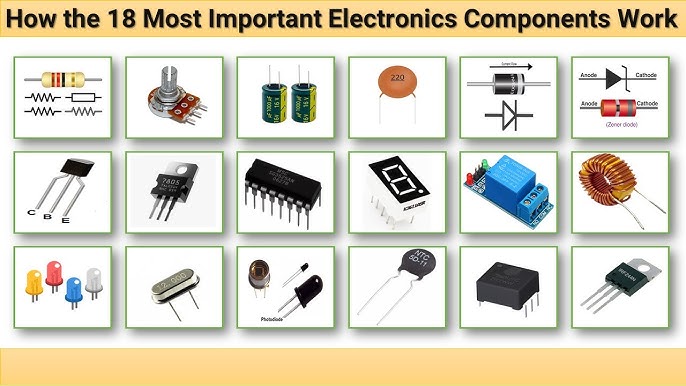
Have you ever wondered what makes your smartphone, TV, or computer actually work? At the heart of every electronic device are basic components that control how electricity flows and how signals are processed.
Understanding these essential parts can open up a whole new world for you—whether you’re curious, a student, or someone looking to build your own gadgets. You’ll discover the key components that make electronics tick, explained in simple terms. By the end, you’ll see how these tiny pieces come together to power the devices you use every day—and maybe even feel inspired to create your own electronic projects.
Keep reading, and let’s break down the basics of electronics for you!
Electronic Components Overview
Electronic components are the building blocks of all electronic devices. They control the flow of electricity and process signals. Understanding these components helps in grasping how gadgets work.
Each component has a unique role. Some store energy, some resist current, and others amplify signals. Together, they create circuits that perform complex tasks.
Resistors limit the flow of electric current. They protect sensitive parts from too much current. Resistors come in various sizes and resistance values.
Capacitors store and release electrical energy quickly. They smooth out voltage changes and filter signals. Capacitors vary in shape, size, and capacity.
Diodes allow current to flow in one direction only. They protect circuits from damage by blocking reverse current. Light Emitting Diodes (LEDs) are a popular type.
Transistors act as switches or amplifiers. They control large currents with small signals. Transistors are key in digital and analog circuits.
Inductors store energy in a magnetic field. They resist changes in current flow. Inductors are useful in filters and transformers.
Integrated Circuits (ics)
ICs combine many components into one small chip. They perform complex functions in a tiny space. ICs power computers, phones, and many devices.
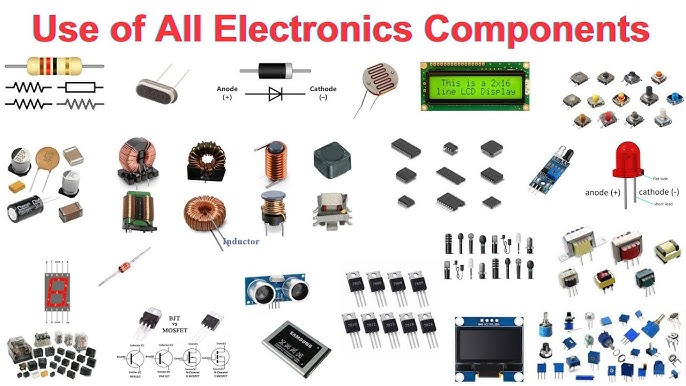
Credit: www.youtube.com
Resistors
Resistors are one of the most fundamental components in electronics. They control the flow of electric current by providing resistance, which helps protect sensitive parts and manage voltage levels. Understanding resistors can give you better control over your circuits and improve your design skills.
Purpose And Function
Resistors limit the current passing through a circuit to prevent damage to other components. They also divide voltage, allowing different parts of a circuit to receive the correct power levels. Without resistors, many electronic devices wouldn’t function safely or efficiently.
Have you ever wondered why some LEDs burn out quickly? It’s often because they didn’t have the right resistor to control current flow. Choosing the right resistor can save your components and extend the life of your projects.
Types Of Resistors
There are several types of resistors, each suited for different uses:
- Fixed Resistors:Provide a constant resistance value. Commonly used in most circuits.
- Variable Resistors (Potentiometers):Allow you to adjust resistance manually, useful for tuning circuits.
- Thermistors:Change resistance with temperature, often used in sensors.
- Photoresistors:Change resistance based on light exposure, ideal for light-sensitive applications.
Knowing which type fits your project can make your design more efficient and responsive.
Applications In Circuits
Resistors appear almost everywhere in electronics. They are used to:
- Protect LEDs by limiting current to safe levels.
- Set bias points in transistors to control amplification.
- Form voltage dividers to create reference voltages.
- Filter signals when combined with capacitors and inductors.
Think about your last DIY project—did you use resistors to control the power? If not, your circuit might have been less reliable than it could be. Adding the right resistor can improve performance and prevent common issues like overheating or erratic behavior.
Capacitors
Capacitors are essential components in almost every electronic device you use daily. They store and release electrical energy quickly, helping circuits work smoothly. Understanding capacitors can give you a clearer picture of how your gadgets function behind the scenes.
Role In Electronics
Capacitors act like tiny energy reservoirs. They store electrical charge and release it when needed, which helps stabilize voltage and power flow in circuits.
They filter out noise in signals, smooth power supply fluctuations, and enable timing functions. Without capacitors, many electronics would experience unstable performance or fail to work altogether.
Different Types
Capacitors come in various types, each suited for specific tasks. Some common types include:
- Ceramic Capacitors:Small and cheap, ideal for high-frequency circuits.
- Electrolytic Capacitors:Larger, with high capacitance; used in power supply filtering.
- Tantalum Capacitors:Stable and reliable, often found in compact devices.
- Film Capacitors:Known for low loss and good stability, used in audio and precision circuits.
Choosing the right type depends on your circuit’s needs, like voltage, size, and stability.
Common Uses
Capacitors appear in many everyday electronics. They help your smartphone charge its battery efficiently and keep the screen flicker-free.
In audio equipment, capacitors filter out unwanted noise, improving sound quality. They also manage power flow in devices like TVs and computers, preventing damage from power spikes.
Next time you see a flickering light or hear static in your headphones, think about how capacitors work hard to fix those issues.

Credit: www.electronicsandyou.com
Inductors
Inductors are key parts of many electronic circuits. They store energy using magnetic fields. This ability helps control current and voltage in devices. Inductors look like coils of wire wrapped around a core. Their size and core type affect their performance. Understanding inductors helps in grasping how circuits work.
Functionality In Circuits
Inductors resist changes in electric current. When current flows, they create a magnetic field. This field stores energy temporarily. When the current changes, the magnetic field changes too. This change induces a voltage that opposes the current shift. This property helps smooth out electrical signals. It also filters noise and stores energy in power supplies.
Varieties Available
- Air Core Inductors:No magnetic core, used in high-frequency circuits.
- Iron Core Inductors:Use iron to increase magnetic field strength.
- Ferrite Core Inductors:Made with ferrite material, common in radio frequency circuits.
- Toroidal Inductors:Coil wound on a doughnut-shaped core for efficient magnetic field containment.
- Variable Inductors:Can adjust inductance manually or electronically.
Use Cases
Inductors appear in many devices and systems. They help in power supplies to store energy. They filter signals in radios and televisions. Inductors smooth out current in audio equipment. They also block high-frequency noise in circuits. Many wireless charging systems use inductors to transfer energy. Understanding these use cases shows their importance in electronics.
Diodes
Diodes are essential components in electronics. They control the direction of electric current. A diode allows current to flow in one direction only. This simple function makes diodes useful in many circuits. They protect components and convert signals effectively. Understanding diodes helps grasp the basics of electronic devices.
Basic Function
A diode acts like a one-way valve for electricity. It lets current pass from its anode to its cathode. Current cannot flow backward through a diode. This property is called “forward bias” and “reverse bias.” In forward bias, the diode conducts electricity. In reverse bias, it blocks the current completely.
Types Of Diodes
- Standard Diode:Used for simple rectification and switching.
- Zener Diode:Allows current to flow backward at a specific voltage.
- Light Emitting Diode (LED):Emits light when current passes through.
- Schottky Diode:Has a low forward voltage drop and fast switching.
- Photodiode:Converts light into electrical current.
Diode Applications
- Convert AC to DC power in power supplies.
- Protect circuits from voltage spikes.
- Generate light in LED displays and indicators.
- Detect signals in radio receivers.
- Control voltage levels using Zener diodes.
Transistors
Transistors are tiny but powerful components that form the backbone of modern electronics. They control the flow of electrical current and act as switches or amplifiers. Without transistors, devices like smartphones, computers, and even household appliances wouldn’t function the way they do today.
Importance In Electronics
Transistors allow you to control large currents with small signals, making complex circuits possible. They have replaced bulky vacuum tubes, making devices smaller, faster, and more energy-efficient.
Think about your smartphone—its processing power depends on millions of transistors working together seamlessly. Without them, the rapid advancements in technology you enjoy wouldn’t exist.
Types And Variants
There are several types of transistors, each designed for specific needs:
- Bipolar Junction Transistors (BJTs):Used for amplification and switching.
- Field Effect Transistors (FETs):Known for high input impedance, ideal for amplifying weak signals.
- Metal-Oxide-Semiconductor FETs (MOSFETs):Widely used in digital circuits due to their efficiency and speed.
Choosing the right transistor depends on your project’s voltage, current requirements, and switching speed.
Practical Uses
Transistors appear in almost every electronic device you use daily. They amplify audio signals in speakers, switch power in motors, and process data in microprocessors.
When you adjust the volume on your headphones, transistors control the signal strength. Ever wonder how your computer handles billions of calculations per second? It’s transistors at work inside the processor chips.
Next time you use any electronic gadget, take a moment to appreciate the tiny transistor that makes it all possible.
Integrated Circuits
Integrated circuits (ICs) are at the heart of almost every electronic device you use daily. They pack countless tiny components into a small chip, making gadgets smaller, faster, and more reliable. Understanding ICs helps you see how complex electronics fit into compact spaces.
Definition And Purpose
An integrated circuit is a small chip made from semiconductor material, usually silicon. It contains many electronic components like transistors, resistors, and capacitors all connected to perform specific functions.
The main purpose of an IC is to replace bulky individual components with a single chip that saves space and energy. This makes devices more efficient and affordable for users like you.
Common Types
- Digital ICs:These handle binary data (0s and 1s) and include microprocessors and memory chips.
- Analog ICs:They process continuous signals, useful in audio amplifiers and radio receivers.
- Mixed-Signal ICs:These combine analog and digital functions, found in devices like smartphones.
Have you ever wondered how your phone processes signals and stores data so quickly? These different types of ICs work together to make that possible.
Impact On Modern Devices
Integrated circuits have transformed electronics by shrinking the size while boosting performance. Your laptop, TV, and even kitchen appliances rely on ICs for smooth operation.
Think about how much smaller and lighter gadgets have become compared to devices from a few decades ago. This is all thanks to IC technology evolving continuously.
Next time you use your smartphone, ask yourself: how would it function without these tiny chips? Understanding ICs reveals the incredible engineering behind everyday convenience.
Switches
Switches are fundamental components in any electronic device. They control the flow of electricity by opening or closing a circuit. Understanding switches helps you design and troubleshoot circuits more effectively.
Basic Role
A switch’s main job is to start or stop the flow of current in a circuit. Think of it as a gate that either allows electricity to pass or blocks it. Without switches, you would have no way to control your devices manually.
Have you ever wondered how your lights turn on and off with a simple flick? That’s the switch doing its job. It provides you the power to control devices safely and conveniently.
Variety Of Switches
Switches come in many types, each suited for different tasks. Common ones include:
- Toggle Switch:Flips between on and off positions easily.
- Push Button Switch:Activates only while pressed.
- Slide Switch:Moves along a track to open or close circuits.
- Rotary Switch:Rotates to select different circuit paths.
Each type offers unique advantages. For example, push buttons work great for temporary actions, while toggle switches provide clear on/off states.
Implementation In Designs
When adding switches to your electronic projects, placement matters. Consider where the user will interact with the device and how often the switch will be used.
Durability also plays a role. Some switches are better for high-usage scenarios, while others suit occasional operation. Selecting the right switch can prevent failures and improve user experience.
Have you tried integrating switches into your projects? Experimenting with different types can reveal which works best for your specific needs.
Power Sources
Power sources are essential in electronics. They supply the energy needed for circuits to work. Without power, no electronic device can operate. Understanding different power sources helps in designing and using electronics effectively.
Types Of Power Supplies
Power supplies come in many forms. The most common types include:
- Direct Current (DC) power supplies
- Alternating Current (AC) power supplies
- Regulated power supplies
- Unregulated power supplies
- Switching power supplies
Each type has specific uses depending on the device’s requirements. DC power supplies provide steady voltage. AC power supplies deliver alternating voltage. Regulated supplies keep voltage stable. Unregulated ones may vary with load. Switching supplies are efficient and lightweight.
Battery Basics
Batteries store chemical energy and convert it to electrical energy. They are portable power sources. Batteries vary in size, voltage, and capacity. Common types include:
- Alkaline batteries
- Rechargeable lithium-ion batteries
- Nickel-metal hydride (NiMH) batteries
- Lead-acid batteries
Batteries provide DC voltage to circuits. Rechargeable batteries can be used multiple times. Non-rechargeable batteries are disposable. Battery choice depends on the device’s power needs and usage time.
Role In Circuitry
Power sources drive current through circuits. They enable components to function properly. Without power, circuits remain inactive. Proper voltage and current levels are crucial. Too much voltage can damage parts. Too little voltage causes malfunction.
Power sources also influence circuit stability. Stable power ensures consistent device performance. Some circuits include power regulators. Regulators maintain voltage within safe limits. Designers must select power sources carefully for each circuit.
Sensors
Sensors are essential parts of electronic devices that help detect and measure physical properties from the environment. They act like the eyes and ears of electronics, gathering information that devices use to respond or make decisions. Without sensors, many modern gadgets wouldn’t be able to interact with the world around them.
Function In Electronics
Sensors convert real-world signals such as temperature, light, or motion into electrical signals that a device can understand. This conversion allows electronic systems to monitor conditions and adjust their behavior automatically. For example, your smartphone’s screen brightness changes based on ambient light detected by a sensor.
Popular Sensor Types
- Temperature Sensors:Measure heat levels, commonly used in thermostats and weather stations.
- Proximity Sensors:Detect the presence of nearby objects without physical contact, found in smartphones and cars.
- Light Sensors:Respond to changes in light intensity, often used in automatic lighting systems.
- Motion Sensors:Sense movement, crucial for security systems and gaming controllers.
- Pressure Sensors:Measure force or pressure, used in medical devices and industrial machines.
Applications In Technology
Sensors play a vital role in smart home systems, helping control lighting, heating, and security based on real-time data. In wearable technology, sensors track health metrics like heart rate and physical activity to give you insights into your fitness. Have you ever wondered how self-driving cars detect obstacles? They rely heavily on a variety of sensors to navigate safely.

Credit: www.electronicsandyou.com
Frequently Asked Questions
What Are The Main Components Of Electronics?
The main components of electronics include resistors, capacitors, inductors, diodes, and transistors. These parts control electrical current and signal flow in circuits.
How Do Resistors Function In Electronic Circuits?
Resistors limit current flow and reduce voltage in circuits. They protect components and control signal levels effectively.
Why Are Capacitors Important In Electronics?
Capacitors store and release electrical energy. They smooth power supply fluctuations and filter signals in circuits.
What Role Do Transistors Play In Electronics?
Transistors amplify signals and switch electronic signals on or off. They are essential for building amplifiers and digital circuits.
Conclusion
Understanding the basic parts of electronics helps you see how devices work. Resistors, capacitors, and transistors all have simple jobs. Each part plays a role in controlling electricity flow. Knowing these parts builds a strong foundation for learning more. Electronics become less confusing with clear ideas.
This knowledge opens doors to many projects and repairs. Start small, and keep exploring step by step. The basics are the first step to bigger skills.
Leave a Reply