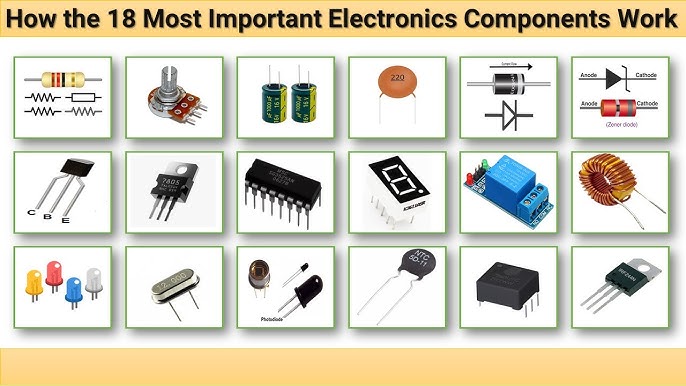
Are you curious about what makes your gadgets work? Understanding the types of electronic components is the key to unlocking how devices around you function.
Whether you’re a beginner or just want to get a clearer picture, knowing these components can empower you to build, fix, or improve your own electronics. Keep reading, and you’ll discover the essential parts that bring your favorite devices to life—and how they might help you create something amazing yourself.

Credit: www.youtube.com
Active Components
Active components are essential parts of electronic devices. They control the flow of electricity and power the circuits. These components can amplify signals, switch currents, and process information. Without active components, electronic gadgets would not function.
Transistors
Transistors act like tiny switches or amplifiers. They control electrical signals in a circuit. Transistors can turn current on or off and boost weak signals. They are found in almost every electronic device, from radios to computers.
Diodes
Diodes allow current to flow in one direction only. They protect circuits from damage by stopping reverse current. Diodes also convert alternating current (AC) to direct current (DC). Light Emitting Diodes (LEDs) are a common type of diode.
Integrated Circuits
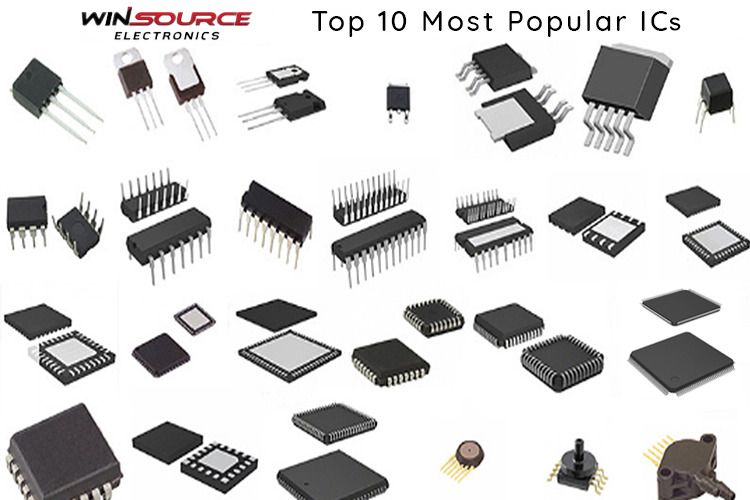
Integrated Circuits (ICs) are small chips that contain many components. They combine transistors, diodes, and resistors in one package. ICs perform complex tasks like processing data and controlling devices. They make electronics smaller, faster, and more reliable.

Credit: www.youtube.com
Passive Components
Passive components are the basic building blocks of electronic circuits. They do not produce energy but store or dissipate it. These components control current and voltage without needing an external power source. Common passive components include resistors, capacitors, and inductors. Each plays a unique role in managing electrical signals and power.
Resistors
Resistors limit the flow of electric current in a circuit. They help control voltage and protect other components. Resistors come in various sizes and values, measured in ohms (Ω). They convert electrical energy into heat, reducing current flow. This simple component ensures circuits work safely and correctly.
Capacitors
Capacitors store electrical energy temporarily. They release energy quickly when the circuit needs it. Capacitors smooth out voltage changes and filter noise from signals. They are measured in farads (F), with many small values used in electronics. Capacitors help maintain stable power supply and improve signal quality.
Inductors
Inductors store energy in a magnetic field when current flows through them. They resist changes in current, smoothing out electrical signals. Inductors are measured in henrys (H). These components are common in filters and transformers. Inductors help control current flow and reduce interference in circuits.
Electromechanical Components
Electromechanical components combine electrical and mechanical processes. They control the flow of electricity through physical movement. These parts are essential in many electronic devices and systems. They help in switching, connecting, and controlling circuits.
Relays
Relays are switches operated by an electrical signal. They use an electromagnet to open or close contacts. This allows a small current to control a larger one. Relays protect circuits by isolating parts from high voltages. They are common in automation and control systems.
Switches
Switches stop or start the flow of electricity. They come in many forms like push buttons and toggles. Switches can be manual or automatic. They are simple but critical for controlling devices. You find switches in almost all electronic gadgets.
Connectors
Connectors join electrical circuits together. They allow easy connection and disconnection of wires. Connectors come in various shapes and sizes. They ensure a secure and stable electrical connection. Connectors are vital for building and maintaining electronics.
Credit: www.electronics-lab.com
Optoelectronic Components
Optoelectronic components are special electronic parts that work with light. They convert electrical signals into light or change light into electrical signals. These components are used in many devices like remote controls, cameras, and fiber optic communication. They help in sensing, signaling, and data transmission using light.
Leds
LEDs or Light Emitting Diodes produce light when electricity passes through them. They are energy-efficient and last long. LEDs come in many colors and sizes. They are used in displays, indicators, and lighting applications.
Photodiodes
Photodiodes detect light and convert it into an electrical current. They work fast and are very sensitive. Photodiodes are used in cameras, light meters, and optical communication systems. They help measure light intensity and receive signals.
Optocouplers
Optocouplers transfer electrical signals using light inside a small package. They isolate different parts of a circuit to prevent damage. Optocouplers are common in power supplies and signal processing. They improve safety and signal quality.
Semiconductor Components
Semiconductor components form the backbone of modern electronics. They control the flow of electricity in devices, making them essential for circuits to function properly. Understanding these components helps you design and troubleshoot electronic projects more effectively.
Mosfets
MOSFETs, or Metal-Oxide-Semiconductor Field-Effect Transistors, act like electronic switches or amplifiers in circuits. They control voltage and current with high efficiency and low power loss. You’ll often find MOSFETs in power supplies, amplifiers, and digital circuits.
One interesting fact is how sensitive MOSFETs are to static electricity. Handling them without proper precautions can easily damage these components, something I learned the hard way during a DIY project. Have you ever experienced a mysterious circuit failure that turned out to be a blown MOSFET?
Bjts
Bipolar Junction Transistors (BJTs) control current flow and amplify signals in circuits. They come in two types: NPN and PNP, which differ by the direction of current flow. BJTs are common in audio amplifiers, switching devices, and signal processing.
BJTs require a small input current to control a larger output current, making them ideal for signal amplification. If you’re working with analog electronics, understanding how to bias BJTs properly can save you a lot of troubleshooting time.
Scrs
Silicon-Controlled Rectifiers (SCRs) are used to control high power with a small input signal. They act like switches that stay on once triggered until the current drops below a certain level. SCRs are popular in motor control, light dimmers, and power regulation.
Have you ever thought about how industrial machines handle sudden power surges? SCRs provide a reliable way to manage that safely. Knowing when to use SCRs instead of other transistors can improve the durability of your circuits significantly.
Power Supply Components
Power supply components are the backbone of any electronic device. They convert and manage electrical energy so your gadgets work smoothly. Understanding these parts helps you troubleshoot issues and even build your own circuits with confidence.
Transformers
Transformers change the voltage level of electric power. They can either step up (increase) or step down (decrease) voltage depending on what your device needs.
Think about charging your phone—transformers reduce the high voltage from the wall outlet to a safe level for your battery. Without transformers, many devices would be at risk of damage or simply wouldn’t function.
Rectifiers
Rectifiers convert alternating current (AC) into direct current (DC). Most electronic devices require DC power to operate properly.
If you’ve ever opened a power adapter, you’ll find rectifiers inside turning the AC from the socket into usable DC. This conversion is vital because it ensures stable power flow, preventing damage to delicate electronics.
Voltage Regulators
Voltage regulators maintain a constant voltage level to your electronic components. They protect your devices from voltage spikes and drops.
Imagine the frustration when your computer crashes due to unstable power—voltage regulators prevent this by keeping the voltage steady. They are essential for sensitive equipment, ensuring long-term reliability and performance.
Sensor Components
Sensors are crucial parts of electronic systems. They detect changes in the environment and convert them into signals. These signals help devices respond to real-world conditions. Sensor components come in many types, each designed for a specific task. They measure temperature, pressure, motion, light, and more. Understanding sensor types helps in choosing the right one for your project.
Temperature Sensors
Temperature sensors measure heat levels. They convert temperature into electrical signals. Common types include thermocouples, thermistors, and infrared sensors. These sensors monitor machines, weather, and home heating systems. They keep devices safe by detecting overheating. Simple, reliable, and widely used in many fields.
Pressure Sensors
Pressure sensors detect force applied on surfaces. They measure gas or liquid pressure. Types include piezoelectric, capacitive, and strain gauge sensors. Used in cars to monitor tire pressure and in factories for fluid control. These sensors improve safety and efficiency in machines.
Motion Sensors
Motion sensors detect movement or acceleration. They include accelerometers, gyroscopes, and infrared sensors. Used in smartphones to detect screen rotation and in security systems for intruder detection. Motion sensors enhance device interaction and safety features.
Wireless Components
Wireless components allow electronic devices to send and receive signals without wires. These parts play a key role in modern communication and connectivity. They enable devices to work over distances and connect to networks or other gadgets.
Wireless components come in various types. Each type has a specific function to support signal transmission and reception. Understanding these helps in choosing the right parts for projects or repairs.
Rf Modules
RF modules send and receive radio signals. They operate on specific frequencies to communicate data wirelessly. These modules are common in remote controls, sensors, and wireless data links. They simplify adding wireless features to devices.
Antennas
Antennas capture and transmit radio waves. They convert electrical signals to wireless signals and vice versa. Different antennas suit different ranges and frequencies. Common types include dipole, patch, and whip antennas. Proper antenna choice improves signal strength and quality.
Bluetooth Modules
Bluetooth modules enable short-range wireless communication. They connect devices like headphones, phones, and computers. These modules use low power and work within a small area. They support easy pairing and data exchange between devices.
Frequently Asked Questions
What Are The Main Types Of Electronic Components?
Electronic components are mainly categorized as passive, active, and electromechanical. Passive components include resistors and capacitors. Active components comprise transistors and diodes. Electromechanical parts include switches and relays. Each type plays a specific role in electronic circuits, ensuring proper functionality and performance.
How Do Passive Electronic Components Work?
Passive components store or dissipate energy without amplification. Resistors limit current flow, capacitors store electrical charge, and inductors store energy in magnetic fields. They do not require external power to operate, making them essential for controlling voltage, current, and signal filtering in electronic circuits.
What Role Do Active Components Play In Electronics?
Active components control electrical signals and provide amplification. They require an external power source to operate. Examples include transistors, diodes, and integrated circuits. These components enable switching, signal modulation, and amplification, making them vital for complex electronic devices and systems.
Why Are Electromechanical Components Important?
Electromechanical components convert electrical signals into mechanical movement or vice versa. Examples include relays, switches, and motors. They enable interaction between electrical circuits and physical actions. These components are crucial for controlling devices and automating processes in various electronic applications.
Conclusion
Electronic components come in many different types. Each type has a special job in a circuit. Resistors control current, capacitors store energy, and transistors act like switches. Understanding these parts helps in building and fixing devices. Knowing their roles makes electronics less confusing.
Keep exploring to learn how these components work together. This knowledge can help in many projects and repairs. Electronics become easier to understand with each step you take. Simple parts. Big impact.
Leave a Reply