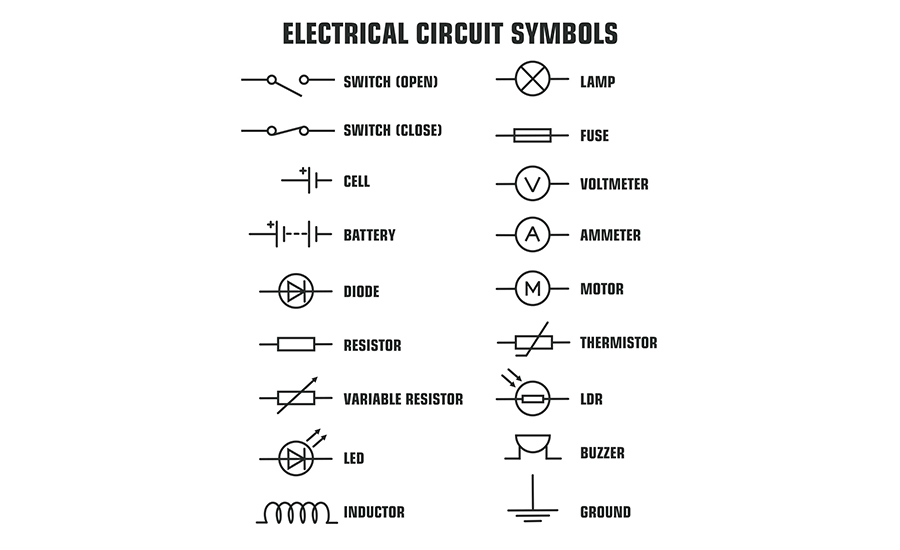
Have you ever stared at an electronic circuit and wondered what those strange symbols really mean? Understanding these symbols is key to unlocking the secrets of any electronic device.
Whether you’re a beginner or just brushing up on your knowledge, knowing which electronic component each symbol represents can save you time, avoid costly mistakes, and boost your confidence. You’ll discover clear explanations that make these symbols easy to recognize and remember.
Ready to decode the language of electronics and take control of your projects? Let’s dive in.

Credit: www.dreamstime.com
Common Symbols In Electronics
Understanding common symbols in electronics is essential for anyone working with circuits. These symbols represent various components and help you read schematics quickly and accurately. Recognizing them can save you time and prevent costly mistakes in your projects.
Resistor Symbol
The resistor symbol looks like a zigzag line or a rectangle, depending on the standard used. It represents a component that limits the flow of electrical current. Have you ever wondered why a resistor is crucial in controlling voltage and protecting sensitive parts?
Capacitor Symbol
The capacitor is shown as two parallel lines with a gap between them, sometimes with one curved line. It stores electrical energy temporarily and releases it when needed. Think about how this helps in smoothing out power supply fluctuations in your devices.
Diode Symbol
The diode symbol features a triangle pointing to a line, indicating the direction of current flow. Diodes allow current to pass in only one direction, which is vital for preventing damage in circuits. Can you imagine what would happen if current flowed backward through sensitive components?
Transistor Symbol
Transistors are depicted with three terminals connected to a combination of lines and arrows. They act as switches or amplifiers in circuits. Understanding this symbol can help you grasp how your smartphone boosts weak signals to clear calls.
Ground Symbol
The ground symbol looks like a set of descending horizontal lines or an inverted triangle. It represents a common return path for electric current and is essential for circuit safety. Why do you think all electronic devices need a reliable ground connection?
Resistor Symbols
Resistor symbols represent components that control electrical current in circuits. They reduce current flow and adjust voltage levels. Understanding these symbols helps in reading circuit diagrams and building electronics.
Fixed Resistor
The fixed resistor symbol is a simple zigzag line or a rectangle. It shows a resistor with a set resistance value. This resistor does not change its resistance during use.
Variable Resistor
The variable resistor symbol looks like a fixed resistor with an arrow across it. The arrow shows that resistance can be adjusted. Variable resistors are used to control current and voltage manually.
Thermistor
The thermistor symbol is a resistor symbol with a diagonal line and a small “T” or curve near it. It changes resistance with temperature. Thermistors help protect circuits by sensing heat changes.
Capacitor Symbols
Capacitor symbols are common in electronic circuit diagrams. They represent components that store and release electrical energy. Recognizing these symbols helps understand circuit functions quickly. Capacitors come in different types, each with distinct symbols.
Polarized Capacitor
Polarized capacitors have a positive and a negative terminal. Their symbol shows one straight line and one curved line. The straight line marks the positive side. It is important to connect them correctly in a circuit. Wrong connection can damage the capacitor or circuit.
Non-polarized Capacitor
Non-polarized capacitors do not have a positive or negative side. Their symbol consists of two parallel straight lines. Both terminals are equal and can connect in any direction. These capacitors work well in AC circuits and signal filtering. They are common in many electronic devices.
Inductor Symbols
Inductor symbols are essential in electronic circuit diagrams. They show where inductors are placed and how they function. Understanding these symbols helps read and design circuits easily. Inductors store energy in a magnetic field when current flows through them. There are different types of inductors, each with a unique symbol.
Air Core Inductor
The air core inductor symbol looks like a simple coil of wire. It has several loops drawn as curved lines or humps. This type of inductor uses air as the core, so it does not contain any metal or magnetic material inside. Air core inductors are common in high-frequency circuits because they have low losses and no magnetic core saturation.
Iron Core Inductor
The iron core inductor symbol is similar to the air core but with added lines. These extra parallel lines represent the iron or magnetic core inside the coil. The magnetic core increases the inductor’s strength and ability to store energy. Iron core inductors are used in low-frequency circuits and power applications where strong inductance is needed.
Diode Symbols
Diode symbols are fundamental in reading and designing electronic circuits. Each symbol tells you how the diode behaves and what role it plays. Understanding these symbols helps you troubleshoot circuits and choose the right component for your project.
Standard Diode
The standard diode symbol looks like a triangle pointing to a line. The triangle represents the direction of current flow, from the anode to the cathode.
This diode allows current to flow in only one direction. Have you ever tried to power a device only to find it wasn’t working? A reversed diode could be the reason.
Zener Diode
The Zener diode symbol is similar to the standard diode but has bent edges on the line. This unique shape indicates its ability to allow current to flow backwards when the voltage reaches a certain level.
Zener diodes are used to regulate voltage, acting as a safety valve for circuits. Think about protecting your gadgets from voltage spikes — Zener diodes make that possible.
Light Emitting Diode (led)
The LED symbol looks like a standard diode but with arrows pointing away from it, showing that it emits light.
LEDs convert electrical energy into light efficiently. Have you noticed how LEDs light up in your devices? That’s the symbol’s promise made real in your circuit board.
Transistor Symbols
Transistor symbols are essential in electronic circuit diagrams. They show how transistors connect and work inside a circuit. Different types of transistors have unique symbols. Understanding these symbols helps in reading and designing electronic schematics. Two common transistor types are Bipolar Junction Transistors (BJTs) and Field Effect Transistors (FETs). Each has distinct symbols that represent their structure and function.
Bipolar Junction Transistor (bjt)
BJT symbols feature three terminals: the emitter, base, and collector. The symbol looks like a combination of arrows and lines. The arrow points outwards for NPN transistors and inwards for PNP transistors. This arrow shows the direction of current flow. BJTs control current flow through the base terminal. They amplify signals in many electronic devices.
Field Effect Transistor (fet)
FET symbols include three terminals: source, gate, and drain. The symbol has a channel line between source and drain. The gate controls the current flow through this channel. There are two main types: JFET and MOSFET. The arrow on the symbol shows the type of FET and current direction. FETs are popular for switching and amplifying signals with low power use.
Switch Symbols
Switch symbols are essential in electronic diagrams because they show how switches control the flow of electricity. Understanding these symbols helps you read and design circuits accurately. Each switch type has a unique symbol that represents its function and connection points.
Single Pole Single Throw (spst)
The SPST switch is the simplest type of switch symbol you’ll see in circuits. It has two terminals and acts like an on/off button, connecting or disconnecting a single circuit path. When the switch is closed, current flows; when open, the circuit breaks.
You’ll recognize the SPST symbol as a straight line touching a break in a line, often drawn like a lever. This design shows the switch’s ability to either allow or stop current. It’s commonly used in basic devices like lamps or simple power controls.
Double Pole Double Throw (dpdt)
The DPDT switch symbol looks more complex because it controls two separate circuits simultaneously. It has six terminals—two inputs and four outputs—and can switch each input between two outputs. This lets you change connections in more intricate ways.
Think of the DPDT symbol as two SPST switches operated by the same lever. This means you can redirect current from one path to another, which is useful in applications like reversing motor directions. Recognizing this symbol helps you work with multi-functional switches effectively.
Connector Symbols
Connector symbols are essential in electronic diagrams. They show where wires or cables join. These symbols help identify the type of connector used. Knowing connector symbols aids in building and troubleshooting circuits. They make diagrams easier to read and understand.
Male Connector
The male connector symbol usually shows pins or prongs. These pins fit into a female connector. The symbol often looks like small lines or dots inside a shape. It represents the part that plugs into another component. Male connectors carry signals or power to the device.
Female Connector
The female connector symbol shows holes or sockets. These accept the male connector’s pins. The symbol may appear as circles or open ends in a shape. It represents the part that receives the connection. Female connectors hold the male pins securely in place.
Power Supply Symbols
Power supply symbols are essential in electronic circuit diagrams. They show the source of electrical energy. Understanding these symbols helps in reading and designing circuits. The most common power supply symbols are for batteries and AC supplies. Each symbol has a unique design that represents its function clearly.
Battery
The battery symbol consists of two or more lines. One line is longer, and the other is shorter. The longer line shows the positive terminal. The shorter line shows the negative terminal. Multiple pairs of lines mean multiple cells in the battery. This symbol tells the circuit where direct current (DC) power comes from.
Ac Supply
The AC supply symbol looks like a sine wave inside a circle. It shows alternating current power. This type of power changes direction regularly. The symbol helps identify parts of the circuit connected to AC mains. It is important for devices that use household electricity.

Credit: www.etechnophiles.com
Ground Symbols
Ground symbols are essential in electronic schematics, representing a common reference point for voltage and current within circuits. Understanding these symbols helps you correctly interpret and build electronic designs. They ensure safety and signal integrity by providing a path for excess charge or interference to dissipate.
Chassis Ground
The chassis ground symbol looks like a series of horizontal lines that get shorter as they go down. This symbol indicates a connection to the metal frame or enclosure of a device.
Chassis grounds protect you from electrical shock by directing stray currents safely into the device’s body. They also help reduce electrical noise by connecting the circuit to a large conductive surface.
Have you ever noticed a buzzing sound when touching a metal case of an electronic device? That often means the chassis ground isn’t connected properly.
Earth Ground
The earth ground symbol features three horizontal lines stacked with the longest at the top and shortest at the bottom, sometimes with a vertical line above.
This symbol represents a direct connection to the earth, often through a grounding rod or metal pipe buried in the ground. It provides a safe path for electrical faults and prevents damage from lightning or power surges.
In homes and industrial setups, earth grounding is critical for safety and equipment protection. Without it, electrical faults could cause fires or serious injuries.
Miscellaneous Symbols
Electronic schematics use a variety of symbols to represent different components, and some don’t fit neatly into common categories like resistors or capacitors. These miscellaneous symbols can be tricky, yet they are essential for understanding complex circuits. Recognizing these symbols can save you time and help you troubleshoot or build devices more effectively.
Fuse
The fuse symbol usually looks like a simple rectangle or a small box with a line through it. Its job is to protect your circuit by breaking the connection if the current gets too high. Have you ever had a device stop working only to find the fuse was blown? Knowing this symbol helps you quickly identify protection points in your circuit.
Antenna
The antenna symbol often appears as a vertical line with several curved lines radiating outward. This symbol indicates where signals are sent or received, especially in wireless communication devices. If you’re working on a radio or Wi-Fi project, spotting the antenna symbol tells you where the signal enters or leaves the circuit.
Transformer
The transformer symbol consists of two coils, sometimes with lines between them representing the magnetic core. Transformers change voltage levels in a circuit, stepping it up or down depending on your needs. Have you ever wondered how your phone charger adapts the high voltage from the outlet to a lower voltage? That’s the transformer’s job.

Credit: www.powerelectronicstalks.com
Frequently Asked Questions
What Does The Electronic Component Symbol Represent?
The symbol represents a specific electronic component, such as a resistor, capacitor, or diode. Recognizing these symbols helps in understanding circuit diagrams accurately.
How To Identify Electronic Components By Their Symbols?
Identify components by noting unique shapes and lines in the symbol. Learning standard symbols improves reading and designing circuit schematics effectively.
Why Are Electronic Component Symbols Important In Circuits?
Symbols simplify complex circuit diagrams, making them easier to read. They provide a universal language for engineers and hobbyists worldwide.
Can One Symbol Represent Multiple Electronic Components?
No, each electronic component has a unique symbol. This distinctiveness prevents confusion when analyzing or building electronic circuits.
Conclusion
Knowing electronic symbols helps read circuit diagrams with ease. Each symbol shows a specific part like resistors or capacitors. Understanding these signs saves time and prevents mistakes. It also makes learning electronics more fun and clear. Keep practicing to recognize more symbols quickly.
This skill builds confidence in working with electronics. Remember, simple steps lead to great progress. Stay curious and keep exploring electronic components.
Leave a Reply