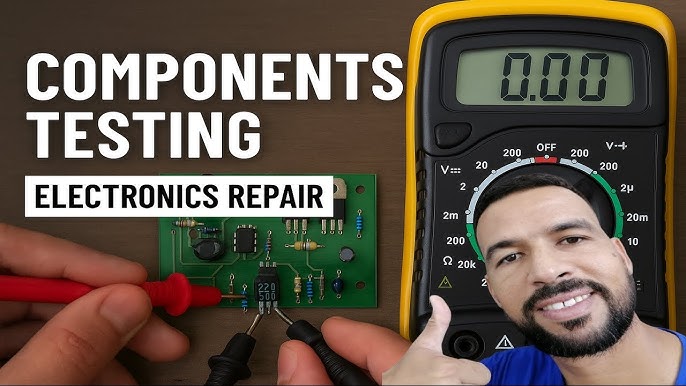
Are you ready to take your skills to the next level in testing electronic components? In this second part of our guide, you’ll discover simple, effective ways to check the health of your devices without confusion or guesswork.
Whether you’re fixing gadgets or building circuits, knowing exactly how to test each component can save you time and money. Keep reading, and by the end, you’ll feel confident in spotting problems before they cause bigger issues. Let’s dive in and make your electronics work perfectly every time.
Advanced Testing Tools
In Part 2 of our exploration of electronic components testing, we delve into advanced tools. These tools provide deeper insights into electronic circuits. They are essential for anyone keen on precision and accuracy in testing.
Oscilloscope Usage
An oscilloscope is vital for visualizing electrical signals. It displays voltage changes over time, offering a graphical view. This tool helps identify signal distortions and noise. It is crucial for diagnosing complex circuitry issues. For accurate readings, ensure your oscilloscope is well-calibrated.
Signal Generators
Signal generators produce specific waveforms for testing. They simulate different signals to test circuit responses. You can adjust frequency, amplitude, and waveform type. This versatility helps in identifying component performance under various conditions. Choose a generator that meets your testing needs.
Logic Analyzers
Logic analyzers are perfect for digital circuit troubleshooting. They capture and display multiple signals from a system. This allows for detailed analysis of digital communication. These tools help diagnose timing issues and logic errors. Ensure you have a compatible logic analyzer for your system type.

Credit: www.flywing-tech.com
Testing Semiconductor Devices
Testing semiconductor devices is crucial to ensure they function correctly in circuits. These components control the flow of electrical current and include diodes, transistors, and integrated circuits. Faulty semiconductors can cause circuit failure or erratic behavior. Using proper testing techniques helps identify defects early. It saves time and prevents damage to other components. Understanding basic test methods makes troubleshooting easier and more efficient.
Diode Testing Methods
Diodes allow current to flow in one direction only. Testing them requires checking this property. Use a digital multimeter set to diode mode. Connect the positive lead to the diode’s anode and the negative to the cathode. A good diode shows a voltage drop of about 0.6 to 0.7 volts. Reverse the leads. The meter should show no conduction or a very high resistance. If the diode conducts both ways or shows no conduction, it is faulty.
Transistor Analysis
Transistors amplify or switch electronic signals. Testing them involves checking the junctions between the base, collector, and emitter. Set the multimeter to diode mode. Test the base to collector and base to emitter junctions. Each should show a voltage drop around 0.6 to 0.7 volts in one direction. Reverse the probes; the meter should show no conduction. Check for shorts between collector and emitter in both directions. Shorts or open junctions indicate a bad transistor.
Integrated Circuit Checks
Integrated circuits (ICs) contain many semiconductor elements. Testing ICs is more complex than single components. First, inspect visually for damage or burnt areas. Check power supply pins for correct voltage. Use a logic probe or oscilloscope to test input and output signals. Compare readings with the IC’s datasheet specifications. For simple ICs, continuity tests on pins can help find broken connections. Faulty ICs often require replacement rather than repair.
Measuring Passive Components
Measuring passive components is vital in electronics testing. These components include capacitors, inductors, and resistors. Each type needs specific techniques to check its health and performance. Accurate measurement ensures circuits work as intended. It also helps find faulty parts quickly.
Capacitor Testing Techniques
Capacitors store electrical energy. Testing them shows if they hold charge properly. Use a digital multimeter with a capacitance setting. Connect the leads to the capacitor terminals. The meter displays capacitance value in microfarads (µF). Compare this with the capacitor’s rated value.
Look for signs of leakage or short circuits. A faulty capacitor may show very low or zero capacitance. An ESR (Equivalent Series Resistance) meter can check internal resistance. High ESR indicates a bad capacitor. For electrolytic capacitors, check for bulging or leaking liquid.
Inductor Evaluation
Inductors store energy in a magnetic field. Measure their inductance with an LCR meter. Connect the meter leads to the inductor. The reading shows inductance in microhenries (µH) or millihenries (mH). Compare this with the specified value.
Check for physical damage, like broken wires or burnt spots. Use a multimeter to test continuity. A reading of zero or infinite resistance means a broken coil. Inductors may also have a small resistance; check it with a multimeter’s ohm setting.
Resistor Accuracy Checks
Resistors limit current flow. Test their resistance using a digital multimeter. Set the meter to the ohm (Ω) range. Connect the leads to each resistor end. Read the resistance value on the display. Compare it with the resistor’s color code or labeled value.
Resistors should be within their tolerance range. Large deviations may cause circuit problems. Check for physical damage like burns or cracks. Damaged resistors often change value or become open circuits.
Circuit Board Troubleshooting
Troubleshooting a circuit board is a key skill for anyone working with electronics. It helps find problems that stop the board from working. This process saves time and money by fixing issues quickly. Knowing how to spot and fix faults keeps devices running smoothly. Below are some important techniques for circuit board troubleshooting.
Identifying Faulty Traces
Faulty traces are breaks or damage in the circuit lines. These breaks stop electricity from flowing correctly. Use a multimeter to check continuity along traces. Touch the probes to both ends of a trace. If the meter shows no connection, the trace is broken.
Visual inspection is also useful. Look for burnt areas or cracks. Use a magnifying glass for a closer look. Repair broken traces by soldering a thin wire over the damaged part. This restores the electrical path.
Cold Joint Detection
Cold joints happen when solder does not bond well. They cause weak electrical connections. These joints look dull or cracked under light. Move the board gently while testing with a multimeter. If the connection changes, a cold joint is likely.
Reheat the joint with a soldering iron to fix it. Add a small amount of fresh solder. This strengthens the connection and improves conductivity.
Short Circuit Isolation
A short circuit happens when two points connect wrongly. It causes excessive current flow and can damage components. Use a multimeter set to measure resistance. Test between power and ground pins.
Low resistance means a short circuit is present. Check for solder bridges or stray wires. Remove any foreign material causing the short. Isolate the short by cutting traces or removing faulty components if needed.
Safety Precautions
Safety is not just a checklist but a mindset when testing electronic components. Ignoring simple precautions can damage sensitive parts or even harm you. Before powering your tools, think about how you can protect both yourself and the devices you’re working with.
Handling Sensitive Components
Some components, like microchips and transistors, are incredibly fragile. Holding them incorrectly can cause physical damage or affect their performance.
Always pick up components by their edges or use tweezers designed for electronics. Avoid touching the pins or leads directly to keep oils and dirt from interfering with connections.
Have you ever noticed a component stop working after just a quick handling? That’s often due to improper grip or accidental bending.
Preventing Electrostatic Discharge
Electrostatic discharge (ESD) is one of the biggest threats to electronic parts. Even a tiny static shock can fry a component instantly.
- Wear an anti-static wrist strap connected to a grounded surface.
- Work on an anti-static mat to reduce static buildup.
- Keep humidity levels moderate; dry air increases static risks.
Think about how often you shuffle your feet on carpet before touching your device—those sparks could be destroying your work silently.
Proper Use Of Test Equipment
Test equipment itself requires careful handling to avoid accidents or inaccurate readings.
- Check your multimeter or oscilloscope settings before connecting to a circuit.
- Use probes with insulated handles to prevent accidental shorts.
- Never test live circuits unless your equipment is rated for it.
Have you ever gotten a wrong measurement and later realized the probe was set incorrectly? Taking a moment to double-check saves time and components.

Credit: www.youtube.com
Interpreting Test Results
Interpreting test results is a crucial skill when checking electronic components. It helps you decide if a part works or needs replacement. Understanding readings avoids mistakes and saves time.
Recognizing Normal Vs Faulty Readings
Every component type shows typical test values. Normal readings match the expected range for the part. Faulty readings often fall outside these limits.
For example, a resistor’s resistance should be close to its labeled value. A big difference means it is faulty. Capacitors may show infinite or zero resistance when broken.
Look for these signs:
- Values much higher or lower than expected
- Open or short circuits
- Unstable or fluctuating readings
Using Reference Data
Reference data helps confirm if a reading is correct. Use datasheets, manuals, or trusted websites. They provide standard values and test methods.
Compare your results to this data carefully. Check the measurement units and test conditions. This ensures accurate interpretation.
Keep a set of common component values handy. It speeds up testing and reduces errors. Reference charts for resistors, capacitors, and diodes prove useful.
Documenting Findings
Write down all test results clearly. Record the component name, test type, and measured value. Note any unusual observations.
Organized records help track component health over time. They assist in troubleshooting and future repairs. Use tables or simple lists for clarity.
Example:
| Component | Test Type | Value | Status |
|---|---|---|---|
| Resistor R1 | Resistance | 100Ω | Normal |
| Capacitor C3 | Capacitance | 0.1µF | Faulty |

Credit: m.youtube.com
Frequently Asked Questions
How Do Multimeters Help Test Electronic Components?
Multimeters measure voltage, current, and resistance in components. They detect faults like open circuits or shorted parts quickly. Using a multimeter is essential for accurate testing and troubleshooting electronic devices effectively.
What Is The Best Way To Test A Capacitor?
Discharge the capacitor fully first. Use a multimeter set to capacitance mode or an ESR meter. Check if the capacitor holds charge and has the correct capacitance value to ensure it functions properly.
How Can You Test A Transistor Easily?
Use a multimeter in diode mode to test transistor junctions. Check the base-emitter and base-collector junctions for correct forward and reverse bias readings to confirm if the transistor is working well.
Why Is Testing Resistors Important Before Use?
Resistors can change value due to heat or damage. Testing ensures they have the right resistance value. Accurate resistor testing prevents circuit malfunctions and improves device reliability.
Conclusion
Testing electronic components helps ensure your projects work well. Use the right tools and follow clear steps to check each part. Practice makes you better and more confident in testing. Keep safety in mind to avoid damage or injury. Stay patient and take your time with each test.
This approach saves time and money in the long run. Keep learning and testing often to improve your skills.
Leave a Reply