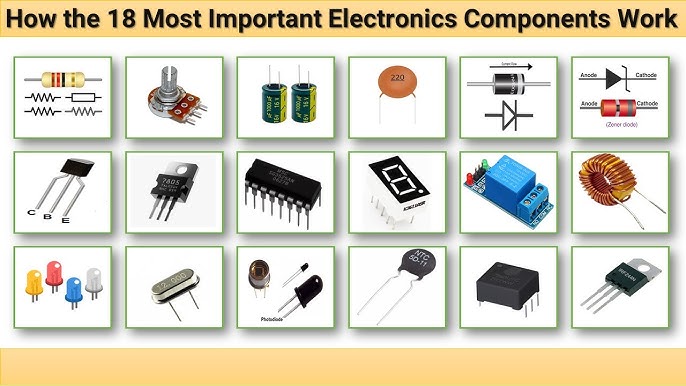
Have you ever wondered what makes your gadgets work? The secret lies in tiny parts called basic electronic components.
These small pieces are the building blocks of every electronic device you use daily. Understanding them can open up a world of possibilities, whether you want to fix your own devices, create cool projects, or simply satisfy your curiosity. Keep reading to discover what these essential components are and how they shape the technology around you.
This knowledge could be the key to unlocking your next great idea!
Common Electronic Components
Basic electronic components include resistors, capacitors, and transistors. These parts control electrical flow in circuits. Understanding them helps build simple electronic devices.
In the world of electronics, understanding basic components is essential. These components form the building blocks of electronic devices. They serve specific functions in circuits. Let’s explore some common electronic components.Resistors
Resistors limit the flow of electric current. They help control voltage and current levels. Without resistors, circuits may face damage from high currents. They come in various types and sizes. Each resistor has a specific resistance value, measured in ohms.Capacitors
Capacitors store and release electrical energy. They help in filtering and smoothing voltages. Capacitors are crucial in power supply circuits. They also play a role in timing applications. Different types include ceramic, electrolytic, and tantalum capacitors.Inductors
Inductors store energy in a magnetic field. They resist changes in current flow. Inductors are used in filters and transformers. They help in tuning circuits. Inductors are often found in power supplies and radios.Diodes
Diodes allow current to flow in one direction. They prevent reverse current flow, protecting circuits. Diodes are used in rectification processes. They convert AC to DC voltage. Light Emitting Diodes (LEDs) are a popular type of diode.Transistors
Transistors amplify and switch electronic signals. They are key components in amplifiers and processors. Transistors come in two main types: NPN and PNP. They form the backbone of modern electronic devices. Transistors have transformed electronics with their versatility.
Credit: www.youtube.com
Functions Of Key Components
Basic electronic components each serve a unique purpose in circuits. Understanding their functions helps grasp how electronic devices work. These components control, store, or modify electric signals. They enable devices to perform tasks like powering, processing, and protecting circuits.
Controlling Current With Resistors
Resistors limit the flow of electric current in a circuit. They protect sensitive parts by reducing current. Resistors also divide voltage and set operating points in circuits. Their value determines how much current they allow to pass.
Storing Energy In Capacitors
Capacitors store electrical energy temporarily. They release energy quickly when needed. Capacitors smooth voltage changes and filter signals. They help stabilize power supply and remove noise from circuits.
Magnetic Fields In Inductors
Inductors store energy in a magnetic field. They resist changes in current flow. Inductors filter signals and block high-frequency noise. They are common in power supplies and radio circuits.
Rectification With Diodes
Diodes allow current to flow in one direction only. They convert alternating current (AC) to direct current (DC). Diodes protect circuits from reverse voltage damage. Their one-way flow is essential in power conversion.
Amplification Using Transistors
Transistors boost weak electrical signals. They act as switches or amplifiers in circuits. Transistors control current flow between two terminals. They are crucial in audio, radio, and digital devices.
How To Identify Components
Identifying electronic components correctly is crucial when building or repairing circuits. Each component carries unique markings or color patterns that tell you its value and type. Knowing how to read these signs can save you from costly mistakes and help you work with confidence.
Color Codes On Resistors
Resistors use colored bands to show their resistance value. These bands follow a specific order, usually four or five colors, each representing a number or multiplier.
- The first two or three bands indicate significant digits.
- The next band shows the multiplier.
- The last band represents tolerance, or how accurate the resistor’s value is.
For example, a resistor with bands brown, black, red, and gold translates to 1, 0, and 100 (multiplier), with ±5% tolerance. Have you ever tried reading resistor colors and mixed up the order? Practice helps you avoid those errors.
Markings On Capacitors
Capacitors usually have their capacitance value printed directly on their body. This might look like numbers followed by letters such as “10uF” or “0.1uF”.
Sometimes you’ll see voltage ratings marked as well, like “16V” or “50V”. These tell you the maximum voltage the capacitor can handle safely.
Be careful with small ceramic capacitors; they often use a three-digit code. For example, “104” means 10 followed by 4 zeros in picofarads, which equals 100,000pF or 0.1μF.
Symbols And Labels
Each component also has a standard symbol used in circuit diagrams and sometimes printed on PCBs. Recognizing these symbols helps you quickly identify parts and understand their connections.
Resistors are usually shown as a zigzag line or a rectangle, capacitors as two parallel lines with or without a curve, and diodes as a triangle pointing to a line.
Labels like R1, C2, or D3 on circuit boards indicate the component type and its number. Have you noticed these labels on your projects? They’re your map to assembling or troubleshooting electronics efficiently.

Credit: www.youtube.com
Basic Tools For Electronics
Getting started with electronics means equipping yourself with the right tools. These tools not only make your work easier but also help you understand how electronic components behave. Without them, you might find troubleshooting or building circuits frustrating and slow.
Multimeter
A multimeter is your go-to device for measuring voltage, current, and resistance. It helps you check if components are working properly and if circuits have continuity. I once spent hours on a project only to realize a faulty resistor—my multimeter saved the day by quickly identifying the problem.
When choosing a multimeter, look for one with easy-to-read displays and multiple measurement modes. This ensures you can test everything from batteries to complex circuits without hassle.
Soldering Kit
A soldering kit is essential for connecting components permanently. It includes a soldering iron, solder wire, and often a stand or cleaning sponge. Using the right soldering technique prevents damage to parts and ensures strong connections.
Don’t rush the soldering process. Taking your time to heat the joint properly and applying solder smoothly improves your circuit’s reliability. Have you ever struggled with cold solder joints? A good soldering kit makes that problem disappear.
Breadboard
A breadboard lets you build circuits without soldering, making it perfect for testing ideas. It has many tiny holes where you insert components and wires to create connections instantly. This tool is great for beginners who want to experiment and learn by doing.
Using a breadboard helps you visualize circuit layouts before making permanent connections. It also allows quick changes, so you can test different setups easily. What circuit idea are you excited to try first on a breadboard?
Simple Circuits Using Basic Components
Simple circuits built from basic electronic components are the foundation of learning electronics. They help you understand how each part behaves and interacts in a real-world setup. These hands-on projects are not only educational but also offer instant feedback, making learning engaging and practical.
By creating simple circuits, you can see how electricity flows, how components like resistors and capacitors affect signals, and how devices like LEDs light up or amplifiers boost sound. Have you ever wondered how a tiny LED can signal a device’s status or how your phone’s microphone makes your voice louder? These circuits reveal those secrets clearly.
Led Circuit
An LED circuit is one of the easiest to build and understand. All you need is an LED, a resistor, and a power source like a battery. The resistor controls the current flowing through the LED, preventing it from burning out.
Try connecting an LED directly to a battery without a resistor—what happens? The LED might burn quickly. This simple experiment teaches you why resistors are crucial. You can also explore using different resistor values to see how the LED brightness changes.
Voltage Divider
The voltage divider is a clever way to reduce voltage to a desired level using just two resistors. It’s useful when you want to power components that need lower voltage than your source provides.
Building a voltage divider helps you grasp how voltage splits across resistors based on their values. You can measure the output voltage with a multimeter and adjust resistor values to get the exact voltage you need. Have you tried powering a sensor with a voltage divider? It’s a practical skill that comes in handy often.
Basic Amplifier
A basic amplifier circuit shows how small signals can be made stronger using transistors or operational amplifiers. This is essential in audio devices, sensors, and communication gadgets.
Constructing a simple amplifier allows you to hear the difference in signal strength. You can start with a single transistor amplifier to boost a weak microphone signal. How much louder can you make a tiny sound? Experimenting with different component values lets you fine-tune the amplification level.
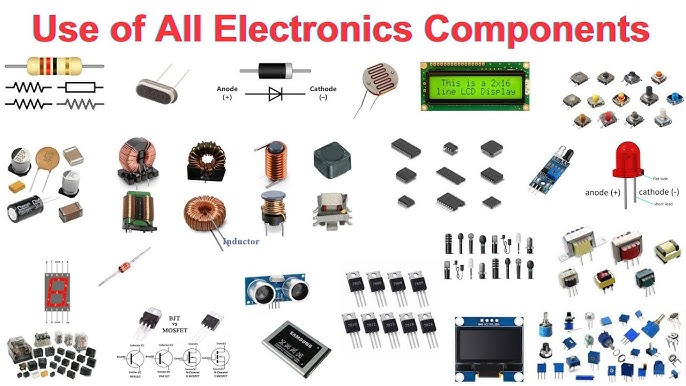
Credit: www.youtube.com
Frequently Asked Questions
What Are The Basic Electronic Components Used In Circuits?
Basic electronic components include resistors, capacitors, diodes, transistors, and inductors. They control current, voltage, and signal flow in circuits.
How Do Resistors Function In Electronic Circuits?
Resistors limit electric current flow and adjust signal levels. They protect components by controlling voltage and current in circuits.
What Role Do Capacitors Play In Electronics?
Capacitors store and release electrical energy. They filter signals, smooth power supply, and block direct current in circuits.
Why Are Transistors Important In Electronics?
Transistors amplify and switch electronic signals. They are fundamental in building amplifiers, switches, and digital logic circuits.
Conclusion
Basic electronic components form the heart of every circuit. They control, store, and direct electric signals. Knowing these parts helps you understand how devices work. Small pieces like resistors, capacitors, and diodes each have unique jobs. These components work together to create complex electronics.
Learning about them is the first step in electronics. Simple and clear knowledge builds a strong foundation. Keep exploring and practicing with these parts. Soon, you will see how everyday gadgets come alive.
Leave a Reply