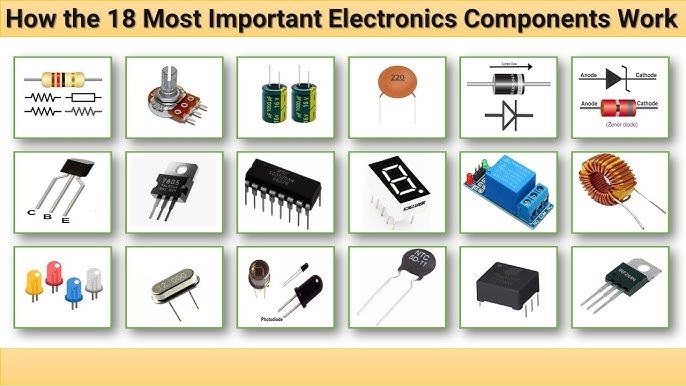
Have you ever wondered what makes your gadgets work? Whether it’s your smartphone, TV, or even a simple flashlight, all these devices rely on tiny parts called electronic components.
Understanding these basic components can open up a whole new world for you—whether you want to fix things, create your own projects, or just satisfy your curiosity. This article will guide you through the essential building blocks of electronics in a clear and simple way.
By the end, you’ll see how these small pieces come together to power the technology you use every day. Ready to unlock the secrets behind your devices? Let’s dive in!
Resistors
Resistors are one of the most common and essential components in electronic circuits. They control the flow of electric current by providing resistance, which helps protect other components and ensures the circuit functions properly. Understanding resistors is key to mastering circuit design and troubleshooting.
Types Of Resistors
Resistors come in various types, each suited for different applications. The most common types include:
- Fixed Resistors:These have a set resistance value and are widely used to limit current or divide voltage.
- Variable Resistors:Also called potentiometers, these allow you to adjust the resistance manually, making them great for tuning circuits.
- Thermistors:These resistors change resistance with temperature, useful in temperature sensing and protection.
- Photoresistors:Their resistance changes based on light intensity, commonly used in light-sensing devices.
Choosing the right type depends on your project needs. Have you tried swapping a fixed resistor with a variable one to see how it changes circuit behavior?
Role In Circuits
Resistors play several vital roles in electronic circuits. They limit current to prevent damage to sensitive components like LEDs and microcontrollers.
They also divide voltage, allowing different parts of a circuit to receive the correct voltage levels. Without resistors, circuits could easily overload and fail.
Think about how a simple resistor saved a project of mine from frying a microcontroller by keeping the current in check. What small component has been a lifesaver in your projects?

Credit: www.youtube.com
Capacitors
Capacitors are fundamental components in electronics that store and release electrical energy. They consist of two conductive plates separated by an insulating material called a dielectric. Capacitors can influence how circuits behave by smoothing signals, blocking direct current, or storing energy for short bursts.
Different Capacitor Types
Capacitors come in various types, each suited for specific tasks. Here are some common ones:
- Ceramic Capacitors:Small, inexpensive, and used for high-frequency applications. You’ll find these in everything from radios to computers.
- Electrolytic Capacitors:Known for their large capacitance values, they are polarized and often used in power supply filters.
- Tantalum Capacitors:Similar to electrolytic but more stable and reliable, ideal for sensitive circuits.
- Film Capacitors:Offer excellent stability and low loss; perfect for precision applications like audio equipment.
- Supercapacitors:Store huge amounts of energy and are used in applications like backup power and energy harvesting.
Have you ever wondered why some capacitors have polarity markings? It’s crucial to connect polarized capacitors correctly to avoid damage.
Capacitor Applications
Capacitors are everywhere in electronics, and their roles can be surprisingly diverse. They help filter out noise from power supplies, ensuring your devices run smoothly.
In timing circuits, capacitors work with resistors to create delays or oscillations—think of the blinking lights or sound tones you might have seen in gadgets.
Energy storage is another key application. For instance, camera flashes use capacitors to build up energy and release it instantly for a bright burst of light.
Have you noticed your smartphone charging faster with newer models? Some of that improvement comes from better capacitor technology managing power flow efficiently.
Inductors
Inductors are one of the fundamental components in electronics. They store energy in a magnetic field when electrical current flows through them. You’ll find inductors in many circuits, especially those involving filters, transformers, and energy storage.
Functionality And Uses
An inductor resists changes in current, which makes it useful for smoothing out electrical signals. This ability helps reduce noise and interference in circuits. If you’ve ever worked with radios or power supplies, you’ve likely encountered inductors managing signal flow and voltage.
Inductors are also key in tuning circuits, like those in radios, where they select specific frequencies. In power electronics, they store energy temporarily, improving efficiency in devices like DC-DC converters. Have you noticed how your phone charger manages power? Inductors play a big role there.
Inductor Variants
- Air Core Inductors:These have no magnetic core and are mainly used at high frequencies.
- Iron Core Inductors:They use a solid iron core to increase inductance and handle higher currents.
- Ferrite Core Inductors:Common in many electronics, ferrite cores reduce energy loss at high frequencies.
- Toroidal Inductors:Shaped like a donut, they are efficient and produce minimal electromagnetic interference.
Choosing the right type depends on your circuit needs. For example, toroidal inductors are great when you want compact size and low noise. What kind of projects are you thinking about where an inductor could make a difference?
Diodes
Diodes are fundamental components in electronics that control the direction of current flow. They act like one-way valves for electric current, allowing it to pass in one direction while blocking it in the opposite. This simple yet powerful behavior makes diodes essential in many electronic circuits.
Diode Types
Diodes come in various types, each designed for specific functions. Here are some common ones:
- Standard (Silicon) Diodes:Used mainly for rectifying AC to DC, found in power supplies.
- Zener Diodes:Allow current to flow backward when voltage exceeds a certain level, useful for voltage regulation.
- Light Emitting Diodes (LEDs):Emit light when current flows through them, used in displays and indicators.
- Schottky Diodes:Have low forward voltage drop, ideal for high-speed switching.
- Photodiodes:Convert light into electrical current, used in sensors.
Understanding these types helps you choose the right diode for your project. Have you ever wondered why some diodes glow while others don’t?
Applications In Electronics
Diodes have a wide range of applications in electronics that you might encounter daily.
- Rectification:Converting AC to DC in power adapters and chargers.
- Voltage Regulation:Protecting circuits by stabilizing voltage with Zener diodes.
- Signal Demodulation:Extracting audio from radio signals.
- Protection:Preventing damage from voltage spikes in sensitive devices.
- Light Indicators:LEDs in displays, flashlights, and remote controls.
When you flip a switch or plug in a charger, diodes are often at work behind the scenes. Could your next DIY project benefit from a diode’s unique abilities?
Transistors
Transistors are tiny electronic switches inside circuits. They control the flow of electric current. This ability makes them crucial for many devices. From radios to computers, transistors help process signals and amplify power.
There are two main types of transistors. Each type works differently but serves a similar purpose.
Bipolar Junction Transistor (bjt)
BJTs have three parts: emitter, base, and collector. They control current using a small input current at the base. This small current can switch or amplify a larger current between emitter and collector.
BJTs are fast and work well in analog circuits. They are common in amplifiers and switches. Their simple design makes them easy to use in many projects.
Field Effect Transistor (fet)
FETs control current with voltage, not current. They have three terminals: source, gate, and drain. A voltage at the gate controls the current flow from source to drain.
FETs use less power than BJTs. They work well in digital circuits and high-frequency applications. Many modern devices use FETs for efficient performance.
Integrated Circuits
Integrated circuits, or ICs, are tiny electronic circuits built on a small chip of semiconductor material. They combine many electronic components like transistors, resistors, and capacitors into one compact unit. This makes devices smaller, faster, and more reliable. ICs form the core of modern electronics, powering everything from smartphones to computers.
Ic Categories
- Digital ICs:Handle binary data using logic gates and flip-flops.
- Analog ICs:Process continuous signals like sound and light.
- Mixed-Signal ICs:Combine both digital and analog functions.
- Memory ICs:Store data in devices such as RAM and ROM.
- Microcontrollers:Include a processor, memory, and input/output controls.
Common Uses Of Ics
- Microprocessors in computers and smartphones.
- Amplifiers in audio and radio equipment.
- Timers and oscillators in clocks and sensors.
- Data storage in USB drives and memory cards.
- Control systems in cars and home appliances.
Switches
Switches are one of the simplest yet most essential electronic components you’ll encounter. They control the flow of electricity in a circuit by opening or closing the path for current. Think of them as the gatekeepers of your electronic projects, giving you the power to turn devices on or off with ease.
Types Of Switches
Switches come in various shapes and functions, each designed for specific uses. Here are some common types you might find:
- Toggle Switch:A lever moves up or down to open or close the circuit. It’s often used in household appliances.
- Push-button Switch:Activated by pressing a button, either momentary (returns to original position) or latching (stays in position).
- Slide Switch:A small switch that slides from one position to another. It’s common in small electronic devices.
- Rotary Switch:Changes circuits by rotating a knob to different positions, often found in older radios and equipment.
- Dip Switch:A set of small switches in a package, used to configure settings on a circuit board.
Switch Applications
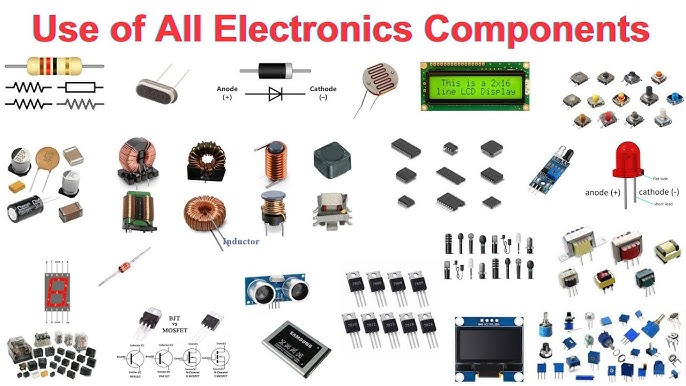
Switches play a vital role in controlling devices and circuits you interact with daily. You use them to turn on lights, start machines, or select modes on gadgets.
In electronics projects, switches allow you to test different circuit paths without rewiring. This saves time and effort, especially when you’re experimenting with designs.
Have you ever thought about how your smartphone’s power button is a type of switch? It’s engineered to handle repeated presses while maintaining reliability.
Switches also improve safety by giving you control over electrical power. Imagine working on a circuit without a switch—you’d have to plug and unplug wires constantly, risking shocks or damage.
Credit: www.youtube.com
Relays
Relays are essential components in electronics used to control circuits. They act like switches that open or close circuits electronically. This allows a small electrical signal to control a larger power load safely. Relays help protect delicate parts from high currents and voltages.
Relay Functionality
A relay works by using an electromagnet to move a switch. When current flows through the coil, it creates a magnetic field. This magnetic field pulls a lever or armature to open or close contacts. These contacts connect or disconnect the power circuit. When the coil is off, a spring returns the switch to its original position.
Relays isolate the control circuit from the power circuit. This separation prevents damage to sensitive components. They are widely used in automation, automotive, and home appliances.
Types Of Relays
- Electromechanical Relays:Use physical moving parts to open or close contacts.
- Solid State Relays:Use electronic components with no moving parts for faster switching.
- Reed Relays:Contain thin metal reeds inside a glass tube, activated by a magnetic field.
- Thermal Relays:Operate by heating a bimetallic strip to open or close contacts.
- Time Delay Relays:Introduce a delay before switching the contacts after coil activation.
Oscillators
Oscillators are essential electronic components that generate repetitive signals, usually in the form of waves. They are the heartbeat of many electronic devices, providing timing and frequency control. Without oscillators, devices like clocks, radios, and computers would struggle to operate accurately.
Purpose In Circuits
Oscillators create continuous waveforms that help maintain timing signals for circuits. These waveforms are critical in tasks like clock generation for processors and signal generation for communication devices. Have you ever wondered how your watch keeps perfect time? That’s the oscillator working quietly inside.
They also help stabilize frequencies, ensuring devices communicate on the right channel without interference. In audio equipment, oscillators produce tones and beats that enhance sound quality. Their ability to produce a steady signal makes them indispensable in many applications.
Common Oscillator Types
Several oscillator types exist, each suited for different needs. Here are some common ones you might encounter:
- Crystal Oscillators:Use quartz crystals to produce very stable frequencies. They are common in watches, radios, and computers.
- RC Oscillators:Use resistors and capacitors to generate low-frequency signals. Often found in audio circuits and timers.
- LC Oscillators:Use inductors and capacitors for higher frequency signals. These are popular in radio transmitters and receivers.
- Relaxation Oscillators:Generate non-sinusoidal waveforms like square or sawtooth waves. They’re used in flashing lights and tone generators.
Choosing the right oscillator depends on your circuit’s frequency stability, waveform shape, and power consumption needs. Have you noticed how different devices require specific oscillator types to work perfectly? That’s why understanding these basics can help you pick the right component for your project.
Sensors
Sensors are devices that detect changes in the environment. They convert physical or chemical signals into electrical signals. Sensors help electronics interact with the real world. They are essential in many electronic circuits and systems. Sensors make devices smarter and more responsive.
Basic Sensor Types
- Temperature Sensors: Measure heat or cold levels.
- Light Sensors: Detect light intensity or brightness.
- Proximity Sensors: Sense the presence of nearby objects.
- Pressure Sensors: Measure force or pressure applied.
- Motion Sensors: Detect movement or vibration.
- Humidity Sensors: Measure moisture levels in the air.
- Gas Sensors: Detect specific gases in the environment.
Sensor Applications
Sensors appear in many everyday devices. They monitor temperature in air conditioners and refrigerators. Light sensors adjust screen brightness on phones and laptops. Proximity sensors help in automatic doors and parking sensors.
Pressure sensors are common in medical devices and cars. Motion sensors improve security systems and smart lighting. Humidity sensors control climate in greenhouses and homes. Gas sensors detect harmful gases for safety in industries.

Credit: www.youtube.com
Frequently Asked Questions
What Are The Essential Types Of Electronic Components?
Essential electronic components include resistors, capacitors, diodes, transistors, and inductors. Each serves a unique function in circuits, such as controlling current, storing energy, or switching signals. Understanding these basics is key to building and troubleshooting electronic devices effectively.
How Do Resistors Function In Electronic Circuits?
Resistors limit the flow of electric current, protecting components from damage. They create voltage drops and control signal levels. Resistors are fundamental for managing current and ensuring circuit stability, making them indispensable in electronic design and repair.
Why Are Capacitors Important In Electronics?
Capacitors store and release electrical energy quickly. They smooth power supply fluctuations and filter signals. Capacitors help maintain stable voltage and improve circuit performance in devices like radios and computers.
What Role Do Transistors Play In Electronics?
Transistors act as switches or amplifiers in electronic circuits. They control current flow and can amplify weak signals. Transistors are crucial for digital logic, signal processing, and power regulation in modern electronics.
Conclusion
Basic electronic components form the heart of all circuits. Each part plays a clear and simple role. Resistors control current, capacitors store energy, and diodes guide flow. Transistors act as switches or amplifiers. Understanding these parts builds a strong foundation.
It helps you read and design circuits with confidence. Electronics become less confusing and more interesting. Keep exploring and practicing with these components. Step by step, your skills will grow. Small parts lead to big ideas. The world of electronics is waiting for you.
Leave a Reply